
Chronic diarrhea is a persistent and often frustrating condition for both veterinarians and dog owners. The diagnostic journey for these pets frequently involves a series of tests and empirical treatments, with antibacterial drugs often being employed before definitive diagnostic procedures like gastrointestinal endoscopy and mucosal biopsies are performed. This indiscriminate use of antibiotics carries significant risks, including the development of antimicrobial resistance, long-term disruption of the delicate intestinal bacterial ecosystem, and the potential exacerbation of gastrointestinal signs in the individual patient. Furthermore, it contributes to the broader public health crisis of antibiotic resistance. This perspective argues for a more judicious approach, advocating for the use of antibacterials only after histopathological evaluation of gastrointestinal biopsies, or in cases where endoscopy is not feasible, after other therapeutic trials such as dietary interventions or anti-inflammatory drugs have proven unsuccessful. Antibacterials should be reserved for canine patients with chronic diarrhea who exhibit signs of a true primary infection, justifying their use, and only after appropriate diagnostic and therapeutic measures have been exhausted.
The standard diagnostic workup for chronic diarrhea in dogs typically encompasses a wide range of laboratory investigations. These include complete blood counts, serum biochemistry panels, urinalysis, fecal examinations, evaluations of pancreatic function and inflammation, endocrine assays (such as adrenal gland function tests), and diagnostic imaging procedures like abdominal radiographs and ultrasounds. Gastrointestinal endoscopy with mucosal biopsies for histopathological examination is a cornerstone of diagnosis. Empirical treatments, often initiated before definitive diagnostics, may include dietary modifications (novel protein or hydrolyzed protein diets), parasiticides, and antibacterials such as metronidazole or tylosin. These interventions are frequently employed because they can offer symptomatic relief in cases of canine chronic enteropathy. Corticosteroids and other immunosuppressants are sometimes necessary but are generally recommended after other treatment strategies have been explored and following biopsy acquisition, which is crucial for diagnosing conditions like intestinal inflammation, lymphangiectasia, infectious agents (including fungal infections and adherent-invasive Escherichia coli), and neoplastic infiltration such as lymphoma.
Antibiotic-responsive diarrhea is recognized as a specific form of chronic enteropathy. Its clinical presentation is often indistinguishable from other types of chronic enteropathy. It is characterized by intestinal microbiota dysbiosis and typically responds well to antibacterial administration, frequently relapsing upon withdrawal of the medication. Commonly used antibiotics for this condition include tylosin (tylosin-responsive diarrhea), metronidazole, and oxytetracycline. Diagnosis relies on a positive response to antibiotics after other conditions have been ruled out. Histopathology of intestinal biopsies in antibiotic-responsive diarrhea may show minimal or no inflammatory changes. However, the empirical use of antibiotics in dogs with chronic diarrhea can lead to their unnecessary administration or overuse, as not all cases ultimately prove to be antibiotic-responsive. This concern is amplified by studies indicating that antibiotic-responsive diarrhea accounts for a relatively small percentage of chronic diarrhea cases (8% to 16.2%). Moreover, research has shown that oral prednisone alone can be as effective as prednisone in combination with metronidazole for dogs with inflammatory bowel disease, suggesting that antibiotics are not always necessary.
The Impact of Antibacterials on the Gut Microbiota
The administration of antibacterial drugs can significantly alter the composition and diversity of the intestinal microbiota in dogs and cats, leading to dysbiosis, which can negatively affect overall host health. Studies in healthy dogs have demonstrated that oral tylosin administration can lead to changes in jejunal bacteria, with increases in organisms like Enterococcus spp. and Pasteurella spp. These microbiota alterations can persist for weeks after the antibiotic is withdrawn, raising concerns about long-term adverse effects. Similarly, metronidazole and amoxicillin have been shown to reduce fecal bacterial diversity and alter fecal bacterial composition, respectively. In some cases, E. coli isolates from dogs treated with amoxicillin have shown increased resistance to multiple antibiotics. While some studies suggest potential indirect probiotic effects of certain antibiotics by promoting the growth of resistant bacteria like enterococci, there remain concerns about the horizontal transfer of antibiotic resistance from commensal bacteria to pathogenic bacteria within the same intestinal environment.
Beyond direct effects on bacterial populations, antibacterials may also influence gut homeostasis through other mechanisms. Research in mice suggests that antibiotic-induced microbiome depletion can alter glucose homeostasis, luminal short-chain fatty acid concentrations, and bile acid metabolism. Additionally, some antimicrobials, like metronidazole, possess immunomodulatory or anti-inflammatory properties. However, using antimicrobials for non-antimicrobial effects is generally discouraged.
Antibiotic Resistance: A Growing Global Threat
Antibiotic resistance is a critical global health problem, with significant implications for companion animals and potential risks to human health. The gut microbiota serves as a reservoir for antibiotic resistance genes, and antibacterial administration can impact this “gut resistome.” Studies have found decreased susceptibility to metronidazole in Clostridium perfringens isolates from dogs with diarrhea, even in those not previously treated with antibiotics. Dogs can also act as reservoirs for antibiotic-resistant strains, such as methicillin-resistant Staphylococcus aureus (MRSA) and Clostridioides difficile, which can pose a threat to human health.
Exploring Alternatives for Gut Microbiota Modulation
There is a growing body of evidence supporting alternative strategies to modulate the bacterial populations in the gut, including the use of prebiotics, probiotics, and synbiotics. Probiotics have shown promise in managing diarrhea, even in dogs with inflammatory bowel disease. Fecal microbiota transplantation (FMT) is another promising modality, particularly for recurrent Clostridioides difficile infections in humans. While a direct equivalent of this condition is not well-established in dogs, the principle of restoring a physiological microbiota suggests that FMT could be beneficial in certain cases of dysbiosis caused by inappropriate antibiotic use. However, large-scale studies on the efficacy and long-term effects of FMT in dogs are still needed. Currently, FMT is not recommended as a routine treatment for diarrhea in dogs due to a lack of robust scientific evidence. Nevertheless, these findings underscore the importance of considering alternatives to broad-spectrum antibiotic use for diarrheic dogs.
A Proposal for the Rational Use of Antibacterials in Canine Chronic Diarrhea
The empirical and injudicious use of antibacterials in dogs with diarrhea should be avoided, especially in light of the global concern for rising antibiotic resistance and the potential negative impacts on individual gut health and public health. Antibacterials should be considered only after appropriate dietary trials have been unsuccessful and, whenever possible, after histopathological evaluation of gastrointestinal biopsies. In cases where biopsies cannot be obtained, antibacterials should be used only after other empirical therapeutic trials have failed.
Antibacterial use may be warranted in specific situations, such as when there are signs of a true primary infection that justifies their use, or in cases where endoscopy or histopathology is inconclusive, and the patient is unresponsive to other treatments. This includes patients exhibiting signs of systemic inflammatory response syndrome (e.g., fever, leukocytosis) or acute infections with known enteric bacterial pathogens that are not self-limiting. However, given the rarity of primary bacterial agents causing non-self-limiting diseases in chronic diarrhea cases, antibacterial use should be reserved for specific conditions and guided by appropriate antibiotic resistance testing. The empirical use of broad-spectrum antibiotics like amoxicillin/clavulanic acid or fluoroquinolones should be avoided.
Figure 1. Diagnostic Algorithm for the Diarrheic Dog
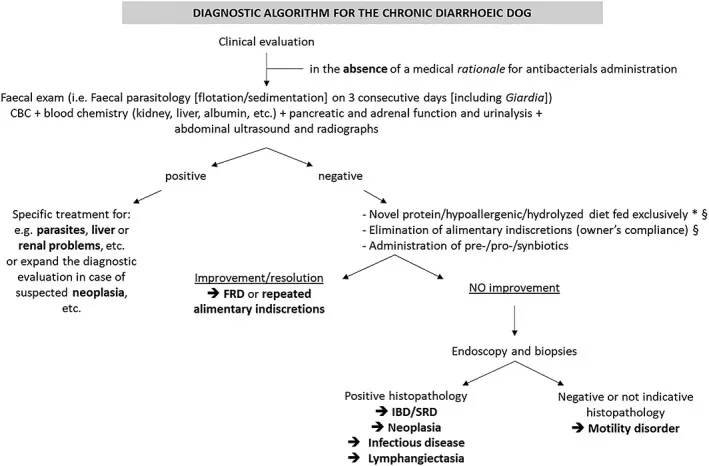
This algorithm, based on combined clinical experience and literature, suggests reserving targeted, not broad-spectrum, antibacterials for chronic diarrheic dogs only at the end of the diagnostic protocol, after GI biopsies have been performed and infectious causes are evident. Dietary trials may require multiple changes and variable durations. Immunosuppressive/steroid-responsive therapy or other trials can be adjusted based on clinical severity. This approach aims to minimize unnecessary antibiotic exposure and promote a more evidence-based management of chronic diarrhea in dogs.
References
- Allenspach, A. L., et al. (2016). Journal of Small Animal Practice, 57(1), 26-34.
- Cammarota, G., et al. (2015). Clinical Infectious Diseases, 61(8), 1322-1326.
- Cammarota, G., et al. (2017). Clinical Infectious Diseases, 65(7), 964-970.
- Chaitman, J., et al. (2016). Journal of Veterinary Internal Medicine, 30(4), 1146-1151.
- Erdmann, A., & Heilmann, R. M. (2017). The Veterinary Journal, 229, 34-42.
- Gobeli, G. M., et al. (2012). Journal of Veterinary Diagnostic Investigation, 24(3), 455-461.
- Hall, E. J. (2011). Veterinary Clinics of North America: Small Animal Practice, 41(3), 527-541.
- Heilmann, R. M., et al. (2018). Journal of Veterinary Internal Medicine, 32(1), 146-157.
- Igarashi, H., et al. (2014). Microbiome, 2(1), 1-13.
- Jergens, A. E., et al. (2003). Journal of Veterinary Internal Medicine, 17(6), 828-835.
- Jergens, A. E., et al. (2007). Journal of Veterinary Internal Medicine, 21(2), 303-307.
- Jergens, A. E., et al. (2010). Journal of Veterinary Internal Medicine, 24(4), 820-824.
- Kilpinen, S., et al. (2015). Journal of Veterinary Internal Medicine, 29(4), 1056-1062.
- Manchester, A. C., et al. (2019). Microbiome, 7(1), 1-12.
- Marks, S. L., et al. (2011). Journal of Veterinary Internal Medicine, 25(3), 459-467.
- Minamoto, Y., et al. (2015). Veterinary Immunology and Immunopathology, 165(1-2), 101-108.
- Nagy, E. (2018). Veterinary Microbiology, 203, 25-31.
- Orden, J. A., et al. (2017). Frontiers in Microbiology, 8, 1893.
- Peter, M., et al. (2017). Frontiers in Microbiology, 8, 983.
- Quraishi, M. N., et al. (2017). Clinical Infectious Diseases, 64(11), 1569-1571.
- Rizzatti, G., et al. (2018). Nature Communications, 9(1), 1-14.
- Rossi, G., et al. (2014). BMC Veterinary Research, 10(1), 1-8.
- Rossi, G., et al. (2018). BMC Veterinary Research, 14(1), 1-10.
- Rossi, L., et al. (2017). Frontiers in Microbiology, 8, 1188.
- Shakir, S. A., et al. (2011). European Journal of Pharmacology, 668(1), 46-53.
- Suchodolski, J. S. (2016). Veterinary Clinics of North America: Small Animal Practice, 46(3), 499-511.
- Suchodolski, J. S., et al. (2009). Veterinary Microbiology, 137(1-2), 101-108.
- Volkmann, D. H., et al. (2017). Journal of Veterinary Internal Medicine, 31(6), 1067-1075.
- von Wintersdorff, C., et al. (2016). Frontiers in Microbiology, 7, 1089.
- Washabau, R. J., et al. (2010). Veterinary Clinics of North America: Small Animal Practice, 40(3), 459-480.
- Weese, J. S., et al. (2015). Veterinary Record, 176(17), 431-433.
- Westermarck, E. (2016). Veterinary Clinics of North America: Small Animal Practice, 46(3), 551-564.
- Westermarck, E., et al. (2005). Journal of Veterinary Internal Medicine, 19(5), 681-685.
- White, R. A., et al. (2017). Journal of Veterinary Internal Medicine, 31(4), 1044-1052.
- WHO (2017). Global action plan on antimicrobial resistance. World Health Organization.
- Zarrinpar, A., et al. (2018). Cell Metabolism, 27(5), 1022-1033.e5.