
Alice Cooper’s decades-long career in rock and roll is packed with outrageous performances, theatrical shock, and unforgettable moments — but few stories from his personal life are quite as surreal as the night he came face to face with Elvis Presley in a Las Vegas hotel room, holding a loaded gun pointed straight at the King of Rock and Roll. It is the kind of encounter that sounds too strange to be true, yet Cooper has recounted it with vivid detail more than once. For fans of oldies music and classic rock history alike, this story offers a rare, intimate window into two of the most iconic figures of 20th-century American music.
An Unexpected Invitation in Las Vegas
The bizarre evening unfolded in 1970, when Alice Cooper received a message that would have startled anyone. “I got a thing that said, ‘Elvis wants to meet you,'” Cooper recalled years later on the BBC television series Never Mind the Buzzcocks. There was no elaborate context, no build-up — just a summons from the King himself.
Cooper was not the only one invited. He found himself in the elevator of the Las Vegas Hilton alongside three equally unexpected guests: actress and singer Liza Minnelli, rock and roll legend Chubby Checker, and actress Linda Lovelace. It was an eclectic gathering by any measure, and things only grew stranger upon arrival.
When the group reached Presley’s floor, they were searched for weapons before being allowed through. Cooper noted the irony with dry humor — “which was kind of silly, because there were guns everywhere once you got in.”
Face to Face with the King
The moment Cooper finally stood before Elvis Presley was everything one might imagine meeting a living legend to be: equal parts thrilling and disarming. Presley, known for his magnetic charisma both on and off the stage, greeted Cooper in the relaxed, self-assured manner that defined his persona.
“He goes, ‘Hey, man. You’re that cat with the snake, ain’t ya?'” Cooper recalled. “I said, ‘Yeah.’ He said, ‘That’s cool, man. I wish I woulda thoughta that.'”
It was a genuine compliment — Elvis Presley, one of the most recognizable names in the golden era of American music, tipping his hat to the theatrical shock rocker who had made a live snake part of his stage act. For a brief moment, two very different worlds of American rock and roll converged.
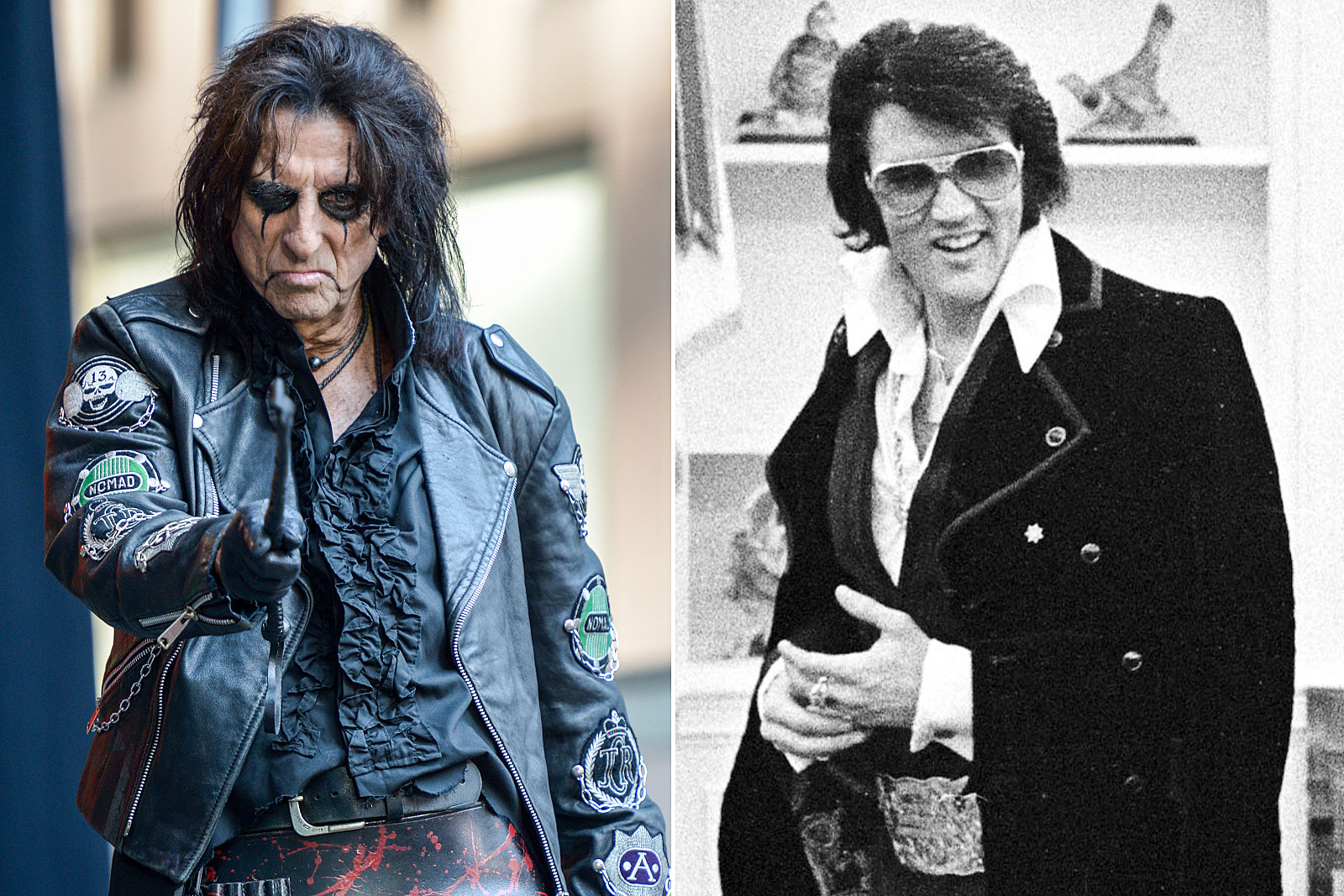
The Loaded Gun in the Kitchen
What followed was perhaps the most surreal moment of Cooper’s storied career. Presley gestured for Cooper to follow him into the kitchen — and what happened next has since become one of the most retold anecdotes in classic rock history.
“He opens the drawer, takes out a loaded .38, snub nose .38, puts it in my hand and he says, ‘I’m gonna show you how to take this gun outta somebody’s hand.'”
Suddenly, Alice Cooper — the man who had built a career on theatrical danger — found himself holding a loaded weapon, aimed at the biggest music star on the planet. The absurdity of the moment was not lost on him.
“The little devil here on my shoulder says, ‘Shoot him,'” Cooper joked in his retelling. “The little angel over here says, ‘Don’t kill him. Just wound him.'”
His internal debate was short-lived. Before Cooper could process what was happening, Presley made his move with practiced speed. “Before I could decide what to do, I was on the floor. And he had his boot on my throat. And I’m going, ‘Argh! That’s good, Elvis.'”
It was a disarming technique — literally — and Presley executed it flawlessly. The King, it turned out, was as formidable in a hotel kitchen as he was on a concert stage.
A Genuine Admiration Between Two Legends
Despite the strangeness of the encounter — or perhaps because of it — Cooper walked away from that night with deep respect for Presley. His recollection carries none of the cynicism that sometimes creeps into celebrity anecdotes. Instead, it reads as the sincere admiration of one artist for another.
“He was an amazing character,” Cooper reflected. “Very funny guy. But he was Elvis.”
That final emphasis says everything. To Cooper, no further explanation was necessary. Elvis Presley existed in a category entirely his own — a musician whose influence on pre-1975 American music remains unmatched, a performer who shaped the cultural identity of an entire generation, and, apparently, a man who kept a loaded .38 in his kitchen and wasn’t shy about using it as a teaching tool.
Why This Story Endures
Anecdotes like this one matter because they humanize the legends of classic American music in ways that discographies and chart histories cannot. Elvis Presley is remembered for “Hound Dog,” “Jailhouse Rock,” and a legacy that stretches across decades of rock and roll history. Alice Cooper is remembered for theatrics, horror imagery, and a brand of rock that pushed every imaginable boundary. Yet in a Las Vegas hotel kitchen in 1970, they were simply two men — one curious, one amused — sharing a moment that neither would forget.
For enthusiasts of oldies music and the broader history of American rock, stories like this serve as a reminder that the artists behind the records were as fascinating, strange, and vibrant as the music itself. The golden era of American music was not just an era of great songs. It was an era of extraordinary personalities.
Conclusion
The night Alice Cooper pointed a loaded gun at Elvis Presley is more than a colorful footnote in rock history — it is a testament to the larger-than-life world that classic American music inhabited. From the unexpected invitation to the elevator ride with Liza Minnelli and Chubby Checker, from the disarming technique on the kitchen floor to Cooper’s affectionate parting words, every detail of this story crackles with the energy of an era when music and mythology were inseparable.
If you love the music and the stories behind it, there is always more to discover. Explore the legends, the anecdotes, and the timeless recordings of America’s greatest musical era — because behind every classic song, there is a story just as unforgettable as the melody itself.