

A high-end classic car dealer takes direct ownership of investment-grade vehicles, maintains verifiable provenance documentation for each unit, and structures transactions through secure, third-party-monitored channels. This distinguishes reputable dealers from brokers who never hold title and private consignors whose history requires independent verification.
Buying a six- or seven-figure classic car without a clear paper trail turns collectors into owners of liabilities, not assets. The core problem is distinguishing a dealer with real inventory ownership, verified provenance protocols, and secure payment handling from a broker relaying someone else’s claims or a private seller with no accountability. This guide gives you the audit framework: the documents to demand, the physical checks to run, and the transaction structure to insist on. A six-figure purchase shouldn’t rest on an assurance you can’t verify.
A high-end classic car dealer takes direct ownership of investment-grade vehicles, maintains verifiable provenance documentation for each unit, and structures transactions through secure, third-party-monitored channels. That distinguishes it from a broker, who never holds title and earns a fee for sourcing and negotiating on a buyer’s behalf. It also differs from a private consignment arrangement, where the original owner keeps title until a sale closes. The distinction matters because it determines who is legally and financially accountable if the vehicle’s history turns out to be misrepresented.
What Makes a High-End Classic Car Dealer?
"High-end" is a marketing term until it’s backed by three concrete markers: facility and inventory scale, documented industry affiliation, and a transaction history that includes complex consignment deals rather than only walk-in retail sales.
Facility scale is the easiest one to verify without leaving your desk. A dealer that publishes inventory count and floor size is inviting scrutiny. Regional dealers like Sherwood Motorcars and Rosner Motorsport market their combined exotic-and-classic mix specifically because it signals depth of inventory, not just a curated handful of cars. Earth MotorCars, for instance, operates from a 70,000-square-foot facility in Carrollton, Texas and lists over 300 vehicles across luxury, exotic, and classic categories — a scale that supports the kind of in-house appraisal and restoration partnerships smaller lots can’t sustain.
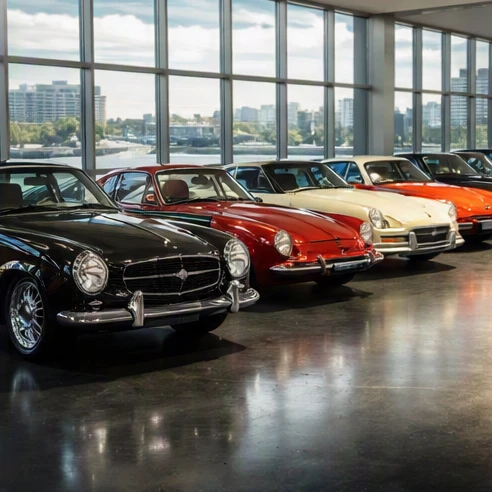
Industry affiliation is the second marker, and it’s where a lot of otherwise polished-looking sites fall short. Membership in bodies such as the Classic Car Club of America, or documented participation in concours events, signals that a dealer’s inventory has been examined by outside judges rather than only self-appraised. A single-line reference to "award-winning inventory" without a named event or class result is a soft claim — treat it the way you’d treat an unverifiable testimonial.
The third marker, reputation metrics, is less about star ratings and more about transaction complexity. Does the dealer handle consignment sales for other collectors — a model Vanguard Motor Sales and RK Motors both use — or only sell cars it already owns? Dealers who take on consignment work are, by necessity, more exposed to due-diligence obligations, because they’re vouching for someone else’s asset and history. Among the best high end classic car dealers in the US, this dual capability — direct sale plus consignment brokerage — tends to correlate with more mature provenance and escrow processes. They’ve had to build those processes to protect their own liability.
One caution on valuation: any figure describing what a given marque or model "is worth" right now should be read as a market estimate drawn from historical auction results, not a fixed price. Auction data moves with condition grading, provenance depth, and collector demand for a given heritage marque. A dealer quoting a specific number without referencing which comparable sales it’s based on is giving you a starting point for negotiation, not an appraisal.
Provenance Verification Processes
Provenance isn’t a single certificate — it’s a hierarchy of evidence, and each tier closes off a different way a car’s history can be misrepresented. Work through it in order, before funds move, rather than accepting a summary from a listing.
- Tier 1: Basic title search and lien verification through state or national databases.
- Tier 2: Ownership chain documentation review, comparing historical registration cards and maintenance invoices.
- Tier 3: Factory build sheet and trim tag authentication against factory dispatch records.
- Tier 4: Comprehensive physical and archival inspection focused on marque-specific production details.

A car that only clears Tier 1 has a clean title — that says nothing about whether the numbers match or the history is complete. Where to buy verified investment grade automobiles comes down, in practice, to which dealers will let you clear Tier 3 before deposit and Tier 4 before final wire release, rather than asking you to take Tier 1 on faith.
Archival Document Types
The paperwork that actually moves the needle on valuation and dispute protection is narrower than most buyers expect. Three categories matter most: the factory build sheet — or a Marti Report-style production record for American makes — continuous ownership records, and, for pre-1990 European cars specifically, a FIVA Identity Card.
A factory build sheet lists the original trim, engine, and options codes assigned at the plant. Cross-referencing it against the car’s current trim tag and casting numbers is how you catch a car that’s been re-optioned, re-engined, or re-bodied after the fact. Ownership history records — title transfers, registration renewals, insurance riders — establish continuity. A gap of several years with no paperwork isn’t automatically fraudulent, but it is a question you should be able to get answered with a specific explanation, not a shrug.
A FIVA Identity Card, issued after a physical inspection by a national vintage vehicle federation, documents the car’s originality against a formal checklist. It’s increasingly requested for international shipping and customs clearance on pre-1970 vehicles, which makes it relevant well beyond the collector-show context it originated in. None of these documents alone proves authenticity beyond dispute. Together, they narrow the space for a seller to misrepresent a car’s history — the standard worth holding a purchase to when the number on the wire transfer has six or seven figures behind it.
Red Flags in Provenance
Paper can be forged; a chassis stamp is harder to fake convincingly. That’s why physical inspection remains the last and most reliable check in the hierarchy. Even so, it should be treated as a strong inspection guideline rather than an infallible test against a sufficiently sophisticated fraud.
Four physical signals are worth learning to check before you rely on a dealer’s word alone:
- Inspect trim tags for non-factory riveting, incorrect fonts, or surface grinding around rivet heads.
- Verify VIN plates for disturbed rosette rivets, repainted perimeter areas, or mismatched character stamping depths.
- Cross-reference engine block casting dates and stamped assembly suffixes with the vehicle build sheet timeline.
- Examine body panel date codes and weld seams for inconsistency with factory production methods.
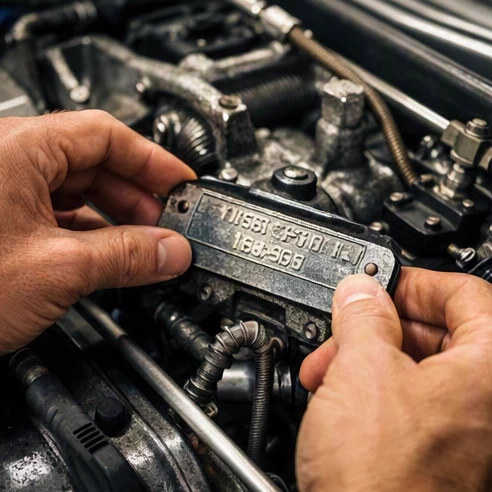
A re-stamped engine block is the classic version of this problem. The numbers are legible and match the paperwork, but the stamping depth, font spacing, or surrounding metal grain doesn’t match factory tooling from that plant and era. That mismatch is usually visible only under raking light or magnification. For any car where authenticity materially affects valuation — even one sold by a well-regarded dealer — a pre-purchase inspection by someone with hands-on familiarity with that specific marque’s production quirks is worth the cost.
Dealer vs Broker vs Consignment: Understanding Service Models
The words "dealer," "broker," and "consignment" get used interchangeably in listings, but they describe three different legal and financial relationships. The difference determines who’s liable if the car’s history turns out to be wrong.
| Service Model | Inventory Ownership | Transaction Process | Fee Structure |
|---|---|---|---|
| Direct Dealership | Dealer owns the vehicle outright | Direct negotiation, immediate title transfer, showroom pickup | Retail markup included in sticker price |
| Automotive Broker | No inventory owned (agent-based) | Sourcing, vetting, and negotiating on behalf of the buyer | Flat sourcing fee or percentage of purchase price |
| Private Consignment | Vehicle owner retains title until sold | Third-party showroom listing with managed viewings | Agreed commission percentage upon successful sale |

That table answers the structural question. What it doesn’t show is where liability actually sits in each model. That matters more than the fee line when you’re deciding how to choose a reputable vintage car broker versus buying direct.
Classic Car Dealers
When a dealer owns the car outright — the model most gallery-style operations such as Daniel Schmitt & Co. and Volo Museum Auto Sales use for their showroom inventory — the dealer is legally the seller of record. Warranty claims, title defects, and misrepresentation disputes route through the dealership directly. Reputable operators back that exposure with in-house appraisal and, often, a limited post-sale support window covering the title and mechanical disclosures made at time of sale.
Brokers
A broker never takes title. Their job is matchmaking: sourcing a specific car for a buyer, vetting it against the buyer’s criteria, and negotiating price. Their fee is typically structured as either a flat sourcing charge or a percentage of the final purchase price. Because the broker isn’t the legal seller, the buyer’s actual contractual recourse runs to whoever does hold title — usually a private owner.
That’s the trade-off. Brokers can access inventory that never reaches a public listing. But a buyer who leans entirely on a broker’s provenance claims without independently verifying documents is accepting more residual risk than one buying from a dealer with direct inventory ownership.
Private Consignment
Consignment sits in between. The original owner keeps legal title until a sale closes, while a showroom or platform handles marketing, viewings, and negotiation in exchange for an agreed commission. Vanguard Motor Sales and RK Motors both run visible consignment programs alongside direct sales. In that structure the consignment house’s incentive is aligned with getting the highest verified price, since its fee scales with it.
Commission rates in this space aren’t standardized. As a working estimate based on how these percentages are typically structured across consignment and brokerage models, figures in the 8–15% range of final sale price are common, scaling down as vehicle value rises. The catch for buyers: because the consignor, not the showroom, is the legal seller, provenance claims should still be traced back to the original owner’s documentation rather than taken as the showroom’s own guarantee.
Secure Transaction Protocols
A verified provenance file protects you from buying a misrepresented car. It does nothing to protect the funds during the days between wire transfer and delivery — a separate risk, and the one most buyers underprepare for on a six-figure purchase.
- Deposit funds into a bonded third-party escrow account with explicit milestone release conditions.
- Include an independent pre-purchase inspection contingency clause tied to mechanical and structural sign-off.
- Secure all-risk bonded transit insurance covering closed-container transport from showroom to destination.
Each step closes a specific failure mode, which is worth walking through rather than treating as a checkbox.
Escrow Services
A bonded third-party escrow account holds the buyer’s funds separately from both the dealer’s and the seller’s operating accounts. It releases them only when contract-defined milestones are met — typically signed purchase agreement, passed pre-purchase inspection, and confirmed title transfer, in that order. That structure protects against the two most common failure modes in high-value private and dealer transactions: funds released before the car is confirmed to match its description, and funds sent directly to a seller’s account with no recourse if the deal falls apart afterward.
Dispute resolution terms should be written into the escrow agreement before funds move, not negotiated after a problem surfaces. At minimum, the agreement should specify who arbitrates a disagreement over inspection results, and what happens to the deposit if the buyer walks for a documented, contract-covered reason versus a simple change of mind.
Logistics and Insurance
Closed-container transit — an enclosed trailer or shipping container rather than an open carrier — is the baseline standard for any car whose insured value runs into six figures. Open transport exposes paint, glass, and trim to road debris and weather for the entire trip. The cost difference is small relative to the asset at risk. Transit insurance should be bound at full agreed value, not at the carrier’s default cargo liability limit. On many commercial auto haulers that limit caps out well below what an investment-grade classic is worth.
Cross-border and multi-state purchases add a legal layer that a showroom’s sales contract typically won’t resolve on its own. Title transfer rules, use taxes, and import duties vary by jurisdiction and by vehicle age. International shipments carrying pre-1970 vehicles increasingly require documentation such as a FIVA Identity Card at customs. Among luxury classic car showrooms with international shipping capability, these are standard commercial practices handled routinely. But the specific tax and title obligations attached to your purchase are jurisdiction-specific. For any cross-border transaction, confirm those obligations with independent legal counsel before wiring funds, rather than relying on a dealer’s summary alone.
Evaluating Dealer Reputation and Credibility
Certifications and affiliations are the fastest due-diligence filter available before you ever call a dealer. They’re either verifiable in minutes or they’re not real.
Certification Bodies
Membership in the Historic Vehicle Association (HVA) or the Fédération Internationale des Véhicules Anciens (FIVA) signals that a dealer’s inventory has been exposed to formal preservation and authenticity standards beyond a standard used-car lot’s paperwork. FIVA membership is tied to the identity card system referenced earlier in the provenance discussion. The Classic Car Club of America maintains its own judging standards for concours-quality vehicles. A dealer whose stock regularly appears at supercars for sale in mumbai or Goodwood-affiliated events has had that inventory examined by outside judges, not just self-described.
Consumer research groups like J.D. Power occasionally publish satisfaction data relevant to luxury dealership service. That data is generally aggregated at the brand-franchise level rather than for boutique classic and exotic specialists — treat it as a general signal rather than a specific rating for a given showroom. Named-marque specialists focused on brands like Aston Martin, Ferrari, McLaren, or Lotus, such as Park Place LTD and Luxury Motorcars, tend to publish more granular technical documentation for exactly this reason: their reputation is tied to a narrower set of collector expectations than a general muscle-car or mixed-inventory lot such as High Octane Classics.
What separates a premier classic car dealer from a standard luxury used-car lot isn’t a single certificate. It’s the combination of a named industry affiliation, a visible history of consignment or auction participation, and a facility built around inventory scale rather than a rotating handful of cars.
Customer Testimonials
Published customer success stories are useful context but weak evidence on their own. Verify them the way you’d verify provenance documents — by checking whether they name a specific transaction, vehicle, and outcome rather than a generic quote.
Red flags run the other direction, too. An absence of any negative review across years of operation is itself worth noting. Even well-run high-value dealerships accumulate the occasional disputed transaction, and a spotless record often means reviews are curated rather than genuinely absent. A safer verification method than reading testimonials in isolation is cross-referencing a dealer’s named transactions against public auction records or registry databases where the vehicle in question appears. If a dealer claims to have sold a specific documented heritage car, that claim should be checkable against a public sale record, not just the dealer’s own site copy.
Before you commit a deposit on any high-end purchase, pull the provenance hierarchy from earlier in this guide and run it against the specific car in front of you. Do that before funds move, not after — it’s the single step that actually determines whether your investment is protected.
FAQ
What are the key certifications to look for in a high-end classic car dealer?
Key markers include membership in recognized bodies such as the Classic Car Club of America, the Historic Vehicle Association, or the Fédération Internationale des Véhicules Anciens (FIVA). Additionally, verifiable participation in concours events or major automotive exhibitions indicates that a dealer’s inventory undergoes formal preservation and authenticity examination by outside judges.
How does a consignment service differ from a dealer in the sale of classic cars?
A direct dealership takes full legal ownership of the vehicle, acting as the seller of record with direct accountability. In a private consignment arrangement, the original owner retains legal title until the sale closes, while a showroom handles marketing and negotiations for a commission percentage, meaning provenance claims must still trace back to the original owner.
What are the red flags to watch for in a classic car’s provenance documentation?
Major red flags include gaps of several years in continuous ownership records without explanation, mismatched factory build sheets versus current trim tags, non-factory riveting on VIN plates or trim tags, and engine block casting dates or stamped assembly suffixes that clash with the vehicle’s production timeline.