
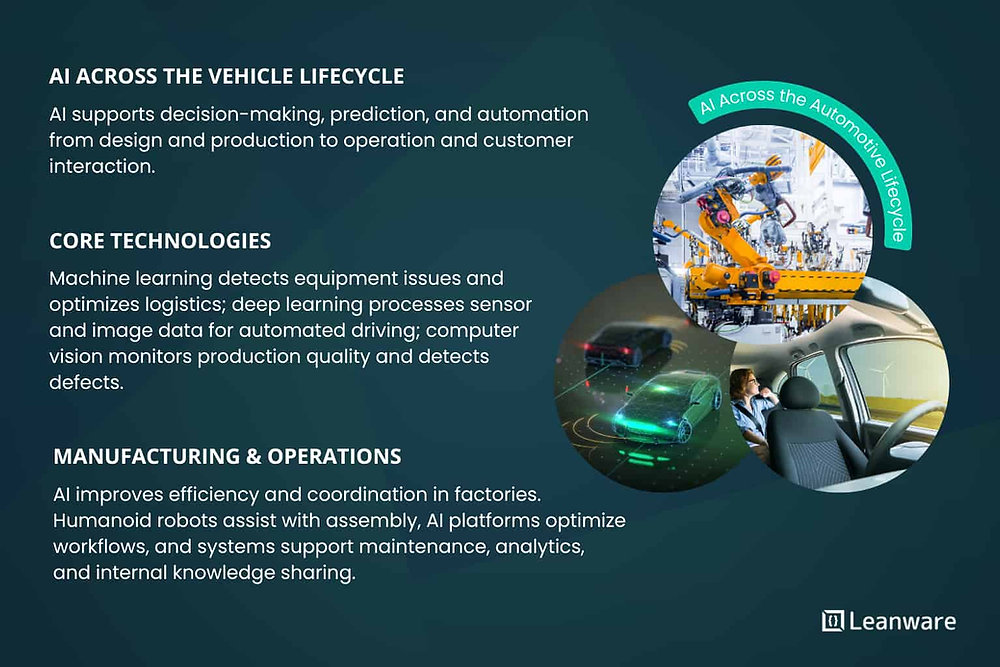
Artificial intelligence (AI) is fundamentally reshaping the automotive industry, driving innovation from vehicle design and manufacturing to how cars are driven and serviced. This technological revolution, encompassing machine learning, deep learning, and computer vision, transforms raw data from drivers and sensors into actionable insights, paving the way for safer, more efficient, and sustainable vehicles and services. The industry’s embrace of AI extends beyond the vehicles themselves, significantly modernizing manufacturing processes and supply chain management. Notably, the automotive sector has been a leader in adopting AI, with a growing interest in agentic AI and generative AI (Gen AI). Key applications transforming the landscape include electric vehicles (EVs), autonomous driving systems (ADAS), and predictive maintenance. A report by the IBM Institute for Business Value highlights the substantial financial impact, with OEM executives anticipating a rise in AI-attributed revenue from 5% to 9% within three years. Furthermore, executives project AI to enhance product value by 22% and digital service value by 37% in the same timeframe.
The Growing Importance of AI in Automotive
Consumer demand for digital innovation is increasing, placing greater emphasis on automakers to adapt. This includes a focus on reducing emissions through EVs, implementing AI-driven dynamic pricing, and offering more personalized dealership experiences. The automotive industry is progressively moving towards a software-defined future, reorienting operations around digital capabilities and experiences. AI systems and automation technologies are pivotal in redefining brand value. A significant majority of global industry executives (74%) surveyed by the IBM Institute for Business Value believe that by 2035, vehicles will be software-defined and AI-powered. Consequently, companies are concentrating on foundational software-defined vehicle (SDV) technologies, integrating AI across all facets of their operations. This strategic shift from a mechanically-driven to a software-driven business model necessitates fundamental changes in traditional thinking. While brand reputation was historically built on design, function, and safety, the advent of SDVs has shifted the focus to data-driven driver and passenger experiences, prompting executives to nearly triple R&D budgets for software and digital investments. The IBM Institute for Business Value report notes that executives anticipate multiple recurring revenue streams from SDV-related features, such as autonomous driving, in-car entertainment, and remote diagnostics. However, the rapid pace of technological advancement presents challenges in predicting customer expectations a decade from now. Ultimately, AI is redefining the digital experience and empowering automakers to differentiate themselves, creating winning customer experiences through AI-driven software that reflects a deep understanding of customer needs.
Key Applications of AI in the Automotive Sector
AI and Gen AI are being deployed across various functions within the automotive industry, with several prominent use cases:
Advanced Driver Assistance Systems (ADAS)
AI, particularly machine learning, serves as the core intelligence behind ADAS. These systems utilize sensors and cameras to gather real-time environmental data, with AI algorithms identifying hazards and initiating necessary actions, such as applying brakes or correcting steering. Examples include lane assist and automatic emergency braking. BMW Group, for instance, has selected Amazon Web Services (AWS) as its cloud provider for the ADAS platform of its 2025 Neue Klasse vehicles.
Automotive Manufacturing and Supply Chain Optimization
In manufacturing, AI enhances supply chain forecasting, identifies production line disruptions, and optimizes inventory. It facilitates real-time material tracking, ensuring parts availability and preventing delays. AI-driven quality control analyzes images and sensor data to detect assembly line defects. Honda, facing challenges in knowledge transfer, partnered with IBM to implement a Gen AI solution, significantly improving efficiency and reducing errors in its engineering processes.
Digital Twins and Generative Simulation
AI enables the creation of digital twins—virtual replicas of physical vehicles or systems that continuously receive data from their real-world counterparts. Enriched with AI and machine learning, these virtual models are crucial for training and validating autonomous driving software, generating traffic simulations, and testing vehicle safety and new features in a virtual environment.
Marketing and Localization
AI drives personalized marketing strategies by analyzing consumer behavior and preferences. It aids in vehicle localization by predicting market demands and customizing features accordingly. Machine learning algorithms help understand regional trends, allowing for tailored product offerings. Scuderia Ferrari HP and IBM collaborated to launch an app for the 2025 Miami Grand Prix, providing fans with a personalized and interactive mobile experience.
Personalized In-Car Experience
AI, powered by natural language processing, enables voice and virtual assistants to control infotainment, navigation, and climate systems. Advanced Gen AI-powered chatbots and agents facilitate human-like, conversational interactions with drivers, understanding context and nuance. AI also curates connected car entertainment experiences based on driver mood and location, with smart features adjusting climate settings and navigation preferences.
Predictive Maintenance and Diagnostics
AI facilitates predictive analytics for automotive maintenance by monitoring vehicle data in real-time to detect anomalies and foresee potential issues before they become critical. This proactive approach minimizes downtime, enhances safety, and optimizes service scheduling, reducing unnecessary repairs.
Software Development
AI accelerates software development for autonomous and connected cars. Machine learning models are used to simulate complex driving scenarios, test vehicle responses, and refine algorithms, leading to faster development cycles and improved vehicle performance. FAW-Volkswagen partnered with IBM to transform its driver experience by guiding the company through designing and scaling solutions for end-to-end transformation.
Training Automation
AI supports the training of autonomous vehicles through simulation environments. These platforms generate diverse scenarios, enabling self-driving systems to learn and adapt without the need for time-consuming and costly physical testing, ensuring consistent and safe training.
Vehicle Design and Prototyping
AI streamlines vehicle design and prototyping using generative design methods. AI can create optimized designs based on specific performance parameters, reducing material usage and weight while enhancing functionality. This technology also expedites prototyping by automating the creation of physical models from digital designs. Hyundai collaborated with IBM iX to create a unified pan-European digital experience platform, ensuring a consistent brand experience for customers.
Benefits of AI Integration in the Automotive Industry
Enhanced Manufacturing Efficiency
AI significantly boosts manufacturing efficiency by automating repetitive tasks, reducing human error, and increasing production speed. AI-driven robotics ensure precise assembly and high-quality output. Predictive analytics minimize production downtime by forecasting equipment failures, enabling preventive maintenance. These advancements lead to higher productivity and cost savings.
Improved In-Vehicle Experience
AI technologies elevate the in-vehicle experience through features like voice recognition, gesture control, and adaptive user interfaces. AI systems learn driver habits and preferences to personalize settings, optimize routes, and provide real-time traffic updates, enhancing comfort, convenience, and safety. AI-powered infotainment systems offer seamless connectivity for multimedia, online services, and smart device integration.
More Personalized Customer Experience
AI enables highly personalized customer experiences throughout the buying journey. AI chatbots provide instant support, while AI-driven analytics help understand customer preferences for tailored marketing and recommendations. Post-purchase, AI-enhanced telematics systems facilitate proactive maintenance notifications and customized feature suggestions.
Optimized Automotive Supply Chain
AI optimizes the automotive supply chain through streamlined inventory management, demand forecasting, and logistics. Accurate demand prediction reduces overproduction or shortages. AI-driven route optimization and real-time tracking enhance delivery efficiency and reduce transportation costs.
Best Practices for Automotive AI Implementation
To effectively navigate the transition to a software-defined future and maintain a competitive edge, automakers should adopt the following best practices:
Embrace Innovation and Continuous Learning
Automakers should foster a culture that embraces innovation, continuous learning, and experimentation with new technologies. Empowering teams to collaborate flexibly across departments and ecosystems is crucial. This requires reorganizing to allow cross-functional teams to share knowledge on vehicle architecture, software platforms, supply chain management, and user experience design. Critical considerations include data privacy, governance, and security. Toyota’s ‘privacy by design’ framework exemplifies a commitment to protecting customer data.
Explore Open-Source Solutions
Adopting open-source solutions for non-differentiating software areas, such as operating systems and middleware, can enhance flexibility and scalability. A significant majority of executives (68%) expect a limited number of standard SDV platforms by 2035, making an open architecture essential for interoperability. Furthermore, adopting digital models and simulations from industries with mature digital product development practices can support the entire lifecycle of a vehicle’s software system.
Innovate with New Ecosystem Partners
The automotive industry should actively seek strategic alliances and partnerships beyond traditional ecosystems, collaborating with tech startups and educational research programs to develop AI models and open innovation platforms. A report by the IBM Institute for Business Value found that nearly half of automotive CIOs, CTOs, and CDOs view partnerships with competitors as essential for competitive advantage.
Invest in Software and Digital R&D
Automakers must significantly increase R&D budgets for software and digital technology. Executives are nearly tripling these budgets, from 21% to 58% by 2025, according to the IBM Institute for Business Value. This investment fuels the development of innovative, data-driven experiences and new business models. Pairing cloud and AI technologies provides a robust R&D toolset, accelerating software development, facilitating experimentation, and supporting data-driven decision-making for optimized SDV features and performance.
The integration of AI into the automotive industry is not merely an upgrade but a fundamental transformation. By embracing these AI-driven advancements and best practices, automakers can position themselves for success in an increasingly digital and connected future.
What are your thoughts on the role of AI in shaping the future of driving? Share your insights in the comments below!