
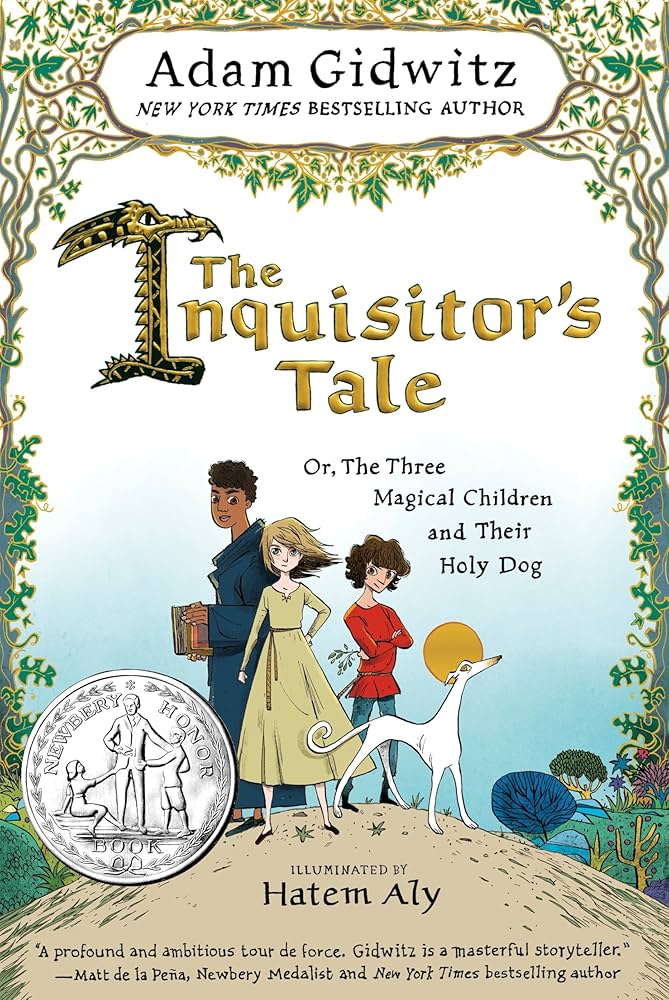
Adam Gidwitz’s The Inquisitor’s Tale stands out in the current literary landscape, particularly within children’s literature, for its daring exploration of faith, prejudice, and the power of storytelling. This middle-grade novel masterfully blends historical fiction with elements of fantasy, creating a narrative that is both wildly entertaining and thought-provoking. It challenges young readers to consider complex themes of religious tolerance and cultural understanding through the lens of a medieval adventure. The book’s unique structure and engaging voice make it a compelling read, offering a fresh perspective on historical events and timeless human experiences.
The story begins with a seemingly simple premise: a dog that was dead to begin with. This resurrected greyhound with a golden muzzle, martyred in defense of a baby, becomes a central figure in a series of tales told in a 1242 English pub. As patrons gather to catch a glimpse of the king, they share stories about this miraculous dog, its vision-prone peasant mistress Jeanne, a monk named William blessed with superhuman strength, and a young Jewish boy named Jacob who possesses healing capabilities. These three disparate children are thrust together amidst a tumultuous France, viewed by some as saints and by others as demonic. Their journey culminates in a dramatic confrontation with the King of France himself. An extensive Author’s Note and Annotated Bibliography are included at the end of the book, providing valuable historical context.
Fans of Gidwitz’s previous Grimm series will recognize his signature penchant for captivating young readers with tales that are not afraid to delve into the darker, more visceral aspects of life. While The Inquisitor’s Tale is set in the Middle Ages – a period Gidwitz insists should not be called “The Dark Ages” – and does not shy away from gore, it feels less overtly violent than some of his earlier works. Despite instances of beheadings and immolations, the carnage is balanced by Gidwitz’s unparalleled skill in crafting disgusting yet humorous descriptions, including ample mentions of vomit and flatulence. His adept use of language, even incorporating the word “ass” with hilarious effect, ensures the book remains engaging and memorable for its target audience.
This novel arrives at a particularly timely moment, addressing crucial themes of religious persecution, fundamentalism, and tolerance. Gidwitz courageously tackles the question of whether historical children’s books can feature protagonists with the prejudices of their era. The three main characters are not portrayed as paragons of tolerance from the outset; their initial interactions reveal deep discomfort with one another due to their differing backgrounds. William, in particular, exhibits a complex mix of learned prejudice and nascent acceptance, showing a dislike for women while begrudgingly acknowledging Judaism. Their journey from wary companions to true friends is built on shared experiences and a common goal, highlighting the slow and challenging process of overcoming ingrained biases.
Religion is a subject rarely explored in depth in middle-grade books from major publishers today, and The Inquisitor’s Tale offers a nuanced examination of its complexities. The novel distinguishes between the folk Christianity of the peasants and the more educated, structured faith of the elite. It depicts a world where pagan traditions influenced peasant beliefs and where the educated sought to suppress these localized practices. The book also touches upon the history of Christian-Jewish relations, with William’s heritage occasionally surfacing. Gidwitz’s extensive Author’s Note clarifies that race relations in Medieval Europe differed significantly from modern understandings, predating the transatlantic slave trade and thus representing a distinct form of societal division.
The true brilliance of The Inquisitor’s Tale lies in its masterful storytelling. Gidwitz breathes life into medieval history, making it feel immediate and relevant. His narrative is rich with character-defining details, such as the observation of a jongleur as someone who has “seen more than most adults” or the poignant simile of a mother’s gaze lingering “like an innkeeper waiting for the last drop of ale.” The author’s ability to weave subtle character notes and evocative descriptions into the fabric of the story is remarkable. For instance, the description of a lord sitting “like a stick of butter slowly melting” or the internal conflict of a character whose “grand castles of comprehension… shivered” showcase Gidwitz’s literary prowess. The inclusion of intricate details, like the marginalia contradicting the text, further demonstrates his meticulous approach to writing.
The structure of the narrative, relying heavily on pub storytelling, allows Gidwitz to explore the inner lives of his characters. While the device of the nun who seems to possess an almost omniscient understanding of the characters’ thoughts and feelings could be seen as a narrative shortcut, it also serves as a thematic element, perhaps an ode to the insightful educators and librarians who guide young minds. The book’s design itself is a testament to its content, with distinct fonts differentiating between the present-day narrative and the tales being told. Artist Hatem Aly’s illuminations add another layer of depth, though the cover illustration of William could be perceived as less imposing than intended.
Ultimately, The Inquisitor’s Tale bridges the gap between fairy tales and saints’ lives, revealing their shared narrative DNA. Gidwitz’s transition from the unadulterated tales of the Brothers Grimm to a story infused with the legends of improbable saints feels natural. More importantly, he skillfully connects these religious narratives to the persistent issue of anti-Semitism. The novel concludes with a powerful message, drawing parallels between the medieval redefinition of living with “the other” and contemporary acts of terrorism. Gidwitz’s assertion that the book is the only “sane” response to such events underscores its profound relevance and enduring impact.
This compelling read is recommended for ages 10 and up.