
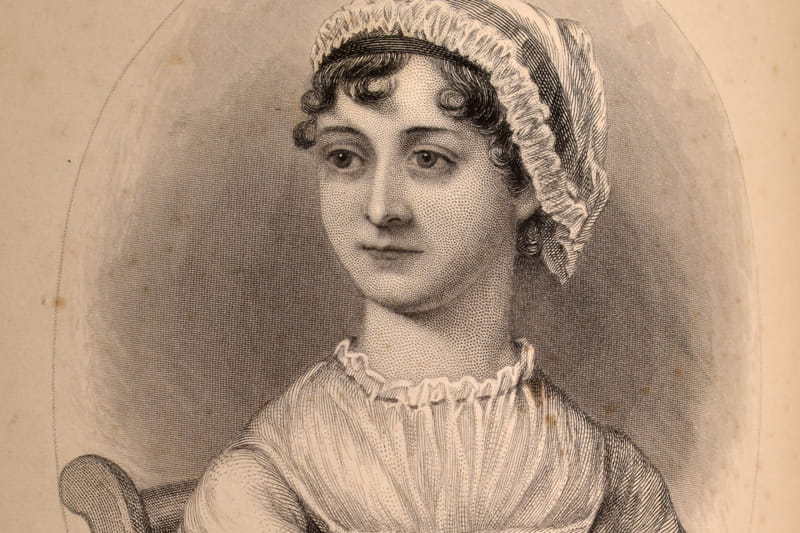
Jane Austen remains one of the most celebrated novelists in English literature, yet the details of her personal life are surprisingly sparse. Born in 1775 in Hampshire, England, she lived a quiet existence that belied the sharp wit and keen social observation evident in her beloved novels. What we know of Austen comes from a handful of surviving letters—most were destroyed by her sister Cassandra—and the recollections of family members who often portrayed her in an almost saintly light. Literary critics, however, suggest a more complex figure: a woman of formidable intelligence, biting humor, and incisive judgment whose true nature her family may have sought to soften for posterity.
Early Life and Family Background
Jane Austen was born on December 16, 1775, in Steventon, Hampshire, the seventh of eight children. She grew up in a close-knit family with six brothers and one sister, Cassandra, who would become her lifelong confidante. Her father, George Austen, was an orphan who, with the assistance of a wealthy uncle, received an education and was ordained in the Church of England. His marriage to Cassandra Leigh in 1764 elevated his social standing, as her family held considerably higher status. In 1765, the couple settled in Steventon, a village roughly 60 miles southwest of London, where George served as rector.
The Austen household was intellectually vibrant. Two of Jane’s older brothers, James and Henry, followed their father into the church, with Henry later serving as Jane’s literary agent and posthumous biographer. Jane was particularly close to Henry throughout her life. Her brother George, the second son, was born with a mental disability and spent most of his life in institutional care. Edward, the third son, was adopted by their father’s wealthy cousin Thomas Knight and eventually inherited the Knight estate in Chawton—the very place where Jane would later complete most of her major novels. The two youngest brothers, Francis and Charles, pursued careers in the Navy and both rose to the rank of admiral.
Education and Early Writing
When Jane was seven, she and Cassandra were sent to Oxford for schooling, but both fell ill with typhus and returned home. At age nine, they attended the Abbey School in Reading, though their enrollment was cut short when their father could no longer afford the tuition. This marked the end of their formal education. Nevertheless, the sisters continued learning at home, supported by their father and brothers, who encouraged intellectual curiosity.
The Austen family regularly read aloud to one another, a practice that evolved into amateur theatrical performances staged in the family barn. Jane contributed to composing these plays, and by age 12, she was writing seriously—producing poems and parodies of the popular dramatic fiction of her day. Her early works included History of England and Love and Freindship [sic], which she later compiled into three volumes: Volume the First, Volume the Second, and Volume the Third.
Youth and Early Romance
Contemporary accounts describe Austen as resembling her brother Henry, with bright hazel eyes and curly hair, and she was known to wear a cap. In her youth, she attracted the attention of Tom Lefroy, a young Irish gentleman. The relationship, however, was not to last; Lefroy was expected to marry into wealth, and he later wed an heiress, going on to become a prominent political figure in Ireland.
The First Trilogy: A Productive Period
In 1795, at age 20, Austen entered a remarkably productive phase, creating what scholars later termed her “First Trilogy.” Encouraged by social engagements and romantic flirtations, she began Elinor and Marianne, a novel written in letters that would eventually be revised and published as Sense and Sensibility. The following year, she completed First Impressions, the early version of Pride and Prejudice. Although a publisher rejected the manuscript in 1797, Austen would later revise it into the masterpiece now cherished worldwide. In 1798, she began another novel titled Susan, which evolved into Northanger Abbey.
The Move to Bath and Personal Struggles
The Austen family’s contentment in Steventon ended abruptly in 1801 when her father announced they would relocate to Bath. Austen was deeply unhappy with the move. Bath, then a fashionable resort town, was populated with gossips and social climbers—an environment that stifled her creative spirit. During a summer journey that year, she fell in love with a young clergyman who promised to meet her at the end of their travels, but he fell ill and died several months later.
Life in Bath proved difficult for Austen. She began but never finished The Watsons and struggled to adapt to the city’s social demands. She briefly accepted a marriage proposal from Harris Bigg-Wither, son of an old family friend, but reversed her decision the following day. In 1805, her father passed away, leaving Jane, Cassandra, and their mother in precarious financial circumstances. For several years, the Austen women relied on the generosity of relatives until they were permanently settled in a cottage in Chawton, Hampshire—a property owned by her brother Edward Austen-Knight.
The Second Trilogy: Literary Triumph
The move to Chawton marked the beginning of Austen’s most productive period. In 1811, she completed final drafts of Sense and Sensibility and Pride and Prejudice, both of which were published shortly thereafter. She immediately began work on Mansfield Park, which appeared in 1814, and then turned to Emma. By this time, Austen was gaining recognition for her work, though her novels were initially published anonymously.
Final Years and Death
While working on Persuasion, her last completed novel, Austen began showing symptoms of what was likely Addison’s disease—a condition characterized by fever, back pain, nausea, and irregular skin pigmentation. Persuasion was published posthumously alongside Northanger Abbey. In her final moments, when her sister Cassandra asked if she needed anything, Austen reportedly requested only “death itself.” She died on July 18, 1817, at age 41, with Cassandra at her side.
Why Jane Austen Endures
Jane Austen’s popularity has only grown since her death, and her works remain beloved by readers and critics alike. Richard Jenkyns, author of A Fine Brush on Ivory: An Appreciation of Jane Austen and a descendant of Austen’s brother, suggests her appeal lies not in nostalgia for a bygone era but in her modernity. “She is popular because she is modern,” Jenkyns observed. “Her popularity is in her representing a world, in its most important aspects, that we know.”
Though Austen wrote in a time and place far removed from contemporary life, her characters experience emotions and navigate social situations that remain deeply familiar. They misjudge others based on appearances, struggle with family dynamics, fall in love, and grapple with societal expectations. These universal themes have allowed her work to be adapted across cultures and eras—from the California high school setting of Clueless to the interracial romance of Bride and Prejudice.
The sheer number of film and television adaptations of her novels, including no fewer than nine versions of Pride and Prejudice, attests to her timeless appeal. Yet even the most successful adaptations, critics argue, cannot fully capture the genius of Austen’s prose—her sharp wit, masterful satire, and the depth of her insight into human nature.
Austen’s Influence on Contemporary Culture
Austen’s influence extends far beyond traditional adaptations. Helen Fielding’s Bridget Jones’s Diary and the film Clueless are among the many works inspired by her novels. A robust literary industry has grown around her legacy, including sequels such as Lady Catherine’s Necklace by Joan Aiken, Mr. Darcy’s Daughters by Elizabeth Aston, and Pemberley: or Pride and Prejudice Continued by Emma Tennant. Contemporary novels like Karen Joy Fowler’s The Jane Austen Book Club and Kate Fenton’s Vanity and Vexation reimagine Austen’s characters and plots in modern settings.
As author Eudora Welty wrote in The Eye of the Story, Austen’s novels endure because “they pertain not to the outside world but to the interior, to what goes on perpetually in the mind and heart.” For these reasons, Jane Austen’s work continues to fascinate, entertain, and inspire readers more than two centuries after her death. Her legacy is not merely that of a beloved novelist but of a keen observer of the human condition whose insights remain as relevant today as they were in Regency England.
References
- Tucker, George Holbert. Jane Austen the Woman. St. Martin’s Press, 1994.
- Laski, Marghanita. Jane Austen and Her World. Charles Scribner’s Sons, 1975.
- “Jane Austen.” Concise Dictionary of British Literary Biography, Volume 3: Writers of the Romantic Period, 1789-1832. Gale Research, 1992.