
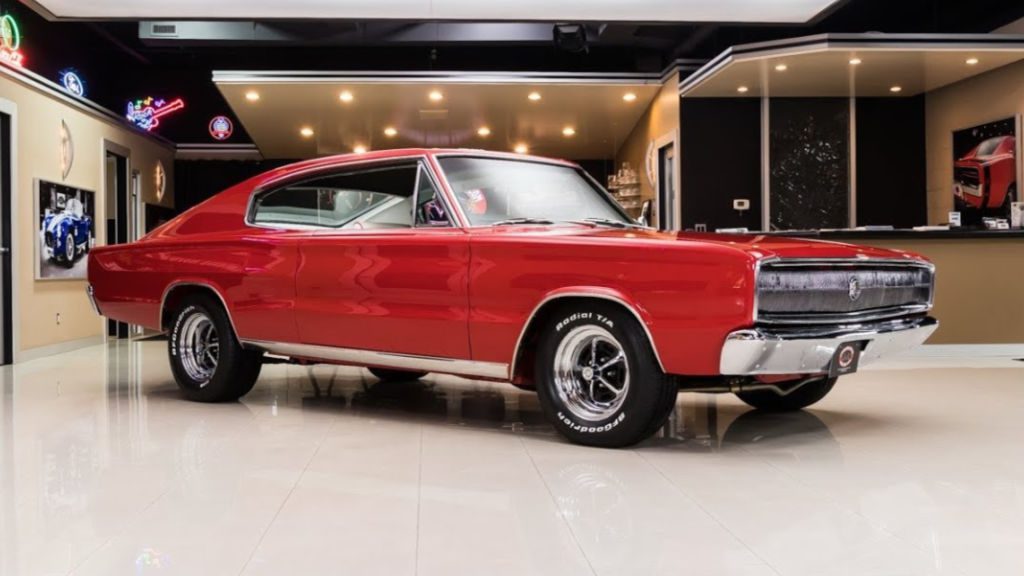
The year 1966 marked a significant leap forward in automotive performance, with muscle cars of this era showcasing a dramatic increase in power and innovation over their 1965 predecessors. This pivotal year saw the highly anticipated street debut of the legendary Hemi engine, forever changing the landscape of American performance vehicles. Following its triumphant, yet controversial, ban from NASCAR in 1964, Chrysler strategically reintroduced its second-generation 426 Hemi to the public in 1966. While detuned for street use, this potent powerplant would soon become a formidable option across Dodge and Plymouth lineups, solidifying 1966 as a landmark year for the muscle car era.
The Hemi Engine Arrives on the Streets
The introduction of the Hemi engine to mainstream American roads in 1966 sent shockwaves through the automotive world. Heralded as “the most powerful sedan ever, bar none” by Car and Driver, these street-legal Hemis were capable of producing 500 horsepower or more. When installed in a Mopar B-body, these early machines could achieve quarter-mile times in the 14-second range, with modifications like the right tires and exhaust systems further improving this to the low 13s and even the 12s. The Hemi engine’s impact on performance was undeniable.
However, the Hemi was not without its challenges. Its substantial price tag made it inaccessible for many potential buyers. Coupled with mandatory accompanying options such as an 11-inch clutch, 11-inch drum brakes, and stiffer shocks, the overall cost, combined with the Dodge B-body’s somewhat understated aesthetics, led to slower-than-expected sales during the Hemi’s initial production run.
Innovative Interior Design: The 1966 Dodge Charger
While the initial 1966 Dodge Charger shared its foundation with the Coronet, featuring distinct hideaway headlights and a fastback roofline, it also introduced groundbreaking interior features. The Charger boasted standard bucket seats and a full-length console that extended through the passenger compartment, effectively splitting the rear seating into two individual buckets. Furthermore, the rear seats could be folded down, significantly expanding cargo space as the interior back panel integrated seamlessly with the trunk. Engine options for this iconic Dodge muscle car were robust, including a 361 cubic inch V8, a four-barrel 383, and the highly sought-after Hemi.
The Pontiac GTO Comes of Age
In 1966, Pontiac elevated its muscle car offerings by granting the GTO full model status, rather than continuing it as an optional package. The standard offering was a powerful 389 cubic inch V8 engine producing 335 horsepower. This new iteration also provided buyers with the choice of a heavy-duty three-speed manual transmission or two different four-speed manual options, both featuring Hurst shifters. While bucket seats remained standard, 1966 marked the first year an optional bench seat was available.
Pontiac also introduced the impressive Tri-Power engine option in 1966, which quickly positioned it as one of the fastest muscle cars of the year. This XS-code 389 package included a functional hood scoop, an upgraded camshaft, and stiffer valve springs. Mandatory options for this performance variant included an M21 close-ratio four-speed transmission, metallic brake linings, a heavy-duty fan, and a 4.33:1 limited-slip differential. With the Hemi’s street-legal release and the GTO’s enhanced status, it was evident that manufacturers were deeply invested in the production of high-performance muscle cars.
The Definitive List of 1966 Muscle Cars
The commitment to performance in 1966 was reflected in the diverse range of models available. From the powerful offerings by Chevrolet and Ford to the distinctive styles of Mercury and Oldsmobile, the year provided something for every enthusiast.
| Year | Make | Model |
|---|---|---|
| 1966 | Buick | Gran Sport |
| 1966 | Buick | Wildcat GS |
| 1966 | Buick | Riviera GS |
| 1966 | Buick | Skylark |
| 1966 | Chevrolet | Bel Air |
| 1966 | Chevrolet | Biscayne |
| 1966 | Chevrolet | Caprice |
| 1966 | Chevrolet | Corvette |
| 1966 | Chevrolet | Malibu SS |
| 1966 | Chevrolet | Chevelle SS |
| 1966 | Chevrolet | Nova SS |
| 1966 | Chevrolet | Impala SS |
| 1966 | Chevrolet | El Camino |
| 1966 | Dodge | Charger |
| 1966 | Dodge | Coronet |
| 1966 | Ford | Mustang GT |
| 1966 | Ford | Fairlane GT/GTA |
| 1966 | Ford | 427 Fairlane |
| 1966 | Ford | Galaxie |
| 1966 | Ford | Falcon |
| 1966 | Ford | Ranchero |
| 1966 | Mercury | Cyclone |
| 1966 | Mercury | Comet |
| 1966 | Oldsmobile | 442 |
| 1966 | Plymouth | Barracuda Formula S |
| 1966 | Plymouth | Belevdere I/II |
| 1966 | Plymouth | Fury |
| 1966 | Plymouth | Satellite |
| 1966 | Pontiac | GTO |
| 1966 | Pontiac | Bonneville |
| 1966 | Pontiac | Catalina |
| 1966 | Pontiac | Grand Prix |
| 1966 | Pontiac | 2+2 |
| 1966 | Royal Pontiac | Bobcat GTO |
| 1966 | Royal Pontiac | Bobcat 2+2 |
| 1966 | Shelby | GT350 |
| 1966 | Shelby | Cobra |
The year 1966 truly cemented the muscle car’s place in automotive history, offering a thrilling array of high-performance vehicles that continue to captivate enthusiasts today. Explore more about the evolution of these iconic machines by checking out our comprehensive guide to 1967 muscle cars.
Related Posts