
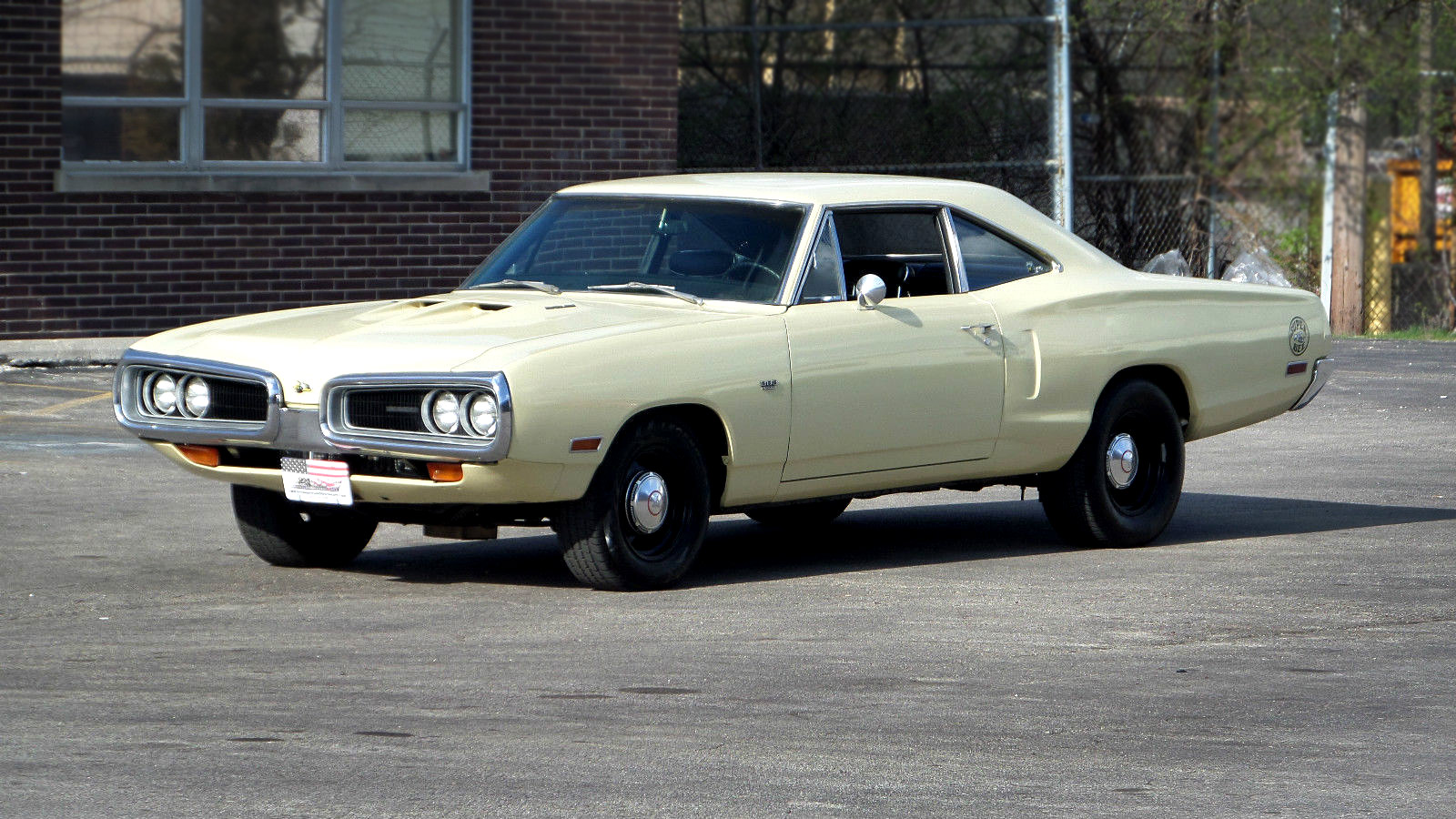
The 1970 Dodge Coronet’s exterior styling was a departure, featuring a distinctive front end with dual-loop bumpers and twin grilles that polarized opinions, earning it the “love-it-or-hate-it” moniker. Today, this unique design is highly prized by collectors. While the 2-door models received updated simulated air scoops, the sculpted rear quarter panels and overall length remained similar to the previous year, with the addition of new delta-shaped taillights. Dodge’s Super Bee, positioned as their budget-friendly performance model, came standard with a 383 Magnum engine, Rallye Suspension, Charger instrument panel, and a 3-speed manual transmission. Optional TorqueFlite automatics and 4-speed transmissions were available, favored by enthusiasts who understood the car’s true potential for street and strip performance.
Six Pack Powerhouse: The 440 Engine
Under the hood, the 1970 Super Bee offered two formidable engine choices: the 426 HEMI, rated at 425 horsepower, and the “Six Pack” variant of the 440 cubic-inch wedge engine, producing 390 horsepower from the factory. The 440 Six Pack was a marvel of engineering, featuring three Holley 2300-series two-barrel carburetors. This setup was designed for both impressive performance under hard acceleration and respectable fuel economy when driven conservatively.
The ingenious design employed a center-mounted 350-cfm two-barrel carburetor for primary fuel delivery, with intake manifold passages engineered for equal distribution to all cylinders. It incorporated standard circuits for idle, primary acceleration, power, and choke. The two outer carburetors, each 500-cfm, operated via primary venturi vacuum, contributing to a total induction system capable of delivering approximately 1,350 cfm, all while ensuring smooth operation and excellent throttle response.
While the Chrysler Six Pack system debuted as a mid-year option in 1969, the 1970 model year saw significant internal upgrades. These included new 10.5:1 pistons, stronger connecting rods with heavier cross-sections, a redesigned camshaft with tapered lobes and a 3-bolt sprocket, a HEMI roller timing set, heavy-duty rocker arms, and HEMI valve springs. The oil pump was upgraded with a 60-psi relief valve, and the intake manifold was now a robust cast iron unit manufactured by Chrysler. This potent powerplant represented a significant upgrade over the standard 383, adding $249.55 to the vehicle’s cost.
High-Performance Cars Magazine put a Six Pack Super Bee through its paces in their January 1970 issue. This particular test car was equipped with power disc brakes, a 3.91 Sure-Grip rear end, and a TorqueFlite transmission. After being “super-tuned” on a chassis dynamometer, it remained otherwise stock. The magazine was highly impressed with the Super Bee’s quarter-mile and street performance. At 60 mph, the engine was reportedly “loafing” at just under 3,000 RPM. Drag strip times ranged from 13.70 to 13.80 seconds, with trap speeds between 101 and 102.50 mph. The publication lauded the Super Bee’s comfort, extensive engine and transmission options, and its dynamic handling and stopping capabilities, concluding that it excelled in many areas.
Dodge’s dealer brochure advertising poetically described the Six Pack system: “if you don’t know what a Six Pack is, go back to your knitting. It’s three two-barrels perched on a special intake manifold, perched on a premium 440.”
Inside the Beast: Interior Appointments
The interior of the 1970 Super Bee featured a standard steering wheel and the Charger model’s dashboard, complete with a faux wood finish. The interior color, specified as “H2XW” on the order sheet, indicated a White Bench Seat with Black Carpet. When paired with the Hurst Pistol Grip 4-speed shifter, the cockpit presented a visually appealing and highly functional environment.
The Bumble Bee Stripe and Legacy
The distinctive Bumble Bee stripe served as an emblem of high-performance Dodge vehicles. On this 1970 Coronet, the white stripe was standard, with an optional longitudinal C-Stripe also available along the quarter panels.
The 1970 Super Bee marked the final year for the model, with the Charger assuming its role as the base for the ‘Bee in 1971. It stands as a prime example of Chrysler’s B-body performance cars. Production records indicate that 10,614 Super Bee Coupes were manufactured for the 1970 model year. The featured car has been meticulously preserved in its original condition, embodying the spirit of Mother Mopar’s intention for a fast, fun, and gear-bangin’ driving experience.
The pictured Plum Crazy Purple Six Pack Super Bee is equipped with the factory RAMCHARGER fresh air package, a 4-speed gearbox, 3.54 gears with a Dana 60 differential, and the iconic White Bumble Bee stripe. Ordered with a focus on performance over excessive options, this car features manual steering and standard drum brakes, retaining its exact factory configuration from September 1969, aside from modern tires. The striking High Impact Purple paint, white stripe, and white interior combination provide significant visual appeal despite the minimal factory options. Currently, the car rides on P245/60R-15 BFG T/A tires mounted on factory code W21 Rallye wheels. While Goodyear Polyglas tires were standard, modern radials are recommended for daily driving.
Fender Tag Details
The car retains its original fender tag, with key codes including E87 (440 Six Pack), N96 (Fresh Air Package), D21 (4-speed transmission), and FC7 (Plum Crazy paint).
Meticulous Restoration and Details
Great care has been taken in the restoration of this Super Bee, with meticulous attention to detail evident both inside and out, preserving its factory equipment.
Dealer Brochure Showcase
Buyers of the 1970 Coronet had a wide array of choices, and the featured car was clearly selected as a high-performance option, presented in a striking and noticeable color.
Author: James Maxwell