
The year 1966 marked a pivotal evolution in the golden era of American performance, as 1966 muscle cars took a massive leap forward in power and prestige compared to their predecessors. While the previous year laid the groundwork, 1966 was defined by a major shift in engineering and marketing. Most notably, it was the year that racing technology truly escaped the confines of the track and arrived in local showrooms, forever changing the expectations of enthusiasts who craved raw, unadulterated speed on Main Street U.S.A.
The Hemi Engine Shakes the Automotive World
The most significant headline of the year was undoubtedly the arrival of the street-legal Hemi. After Chrysler’s Gen II 426 Hemi dominated stock car racing in 1964—taking home 26 checkered flags—it was subsequently banned from competition. To satisfy NASCAR’s homologation rules and pacify race officials, Chrysler decided to offer a slightly detuned version of this legendary powerhouse to the general public.
This move hit the muscle car world like a lightning bolt. Car and Driver famously dubbed it “the most powerful sedan ever, bar none.” In factory trim, most street Hemis were capable of producing 500 horsepower or more. When dropped into a Mopar B-body chassis, these machines could clock 14-second quarter-mile times right off the showroom floor. With minor modifications like better tires and exhaust systems, those times easily dipped into the low 13s and even the high 12s, cementing the Hemi’s status as a street-racing king.
However, owning a legend came at a steep price. The engine itself was expensive, and Chrysler required “mandatory options” like heavy-duty 11-inch drum brakes, stiffer shocks, and an 11-inch clutch. These costs, paired with the somewhat conservative styling of the Dodge B-body, meant that while the Hemi earned eternal fame, it remained a rare sight on the roads in 1966.
Innovation and Style: The Dodge Charger
While the Hemi provided the muscle, Dodge also focused on futuristic design with the introduction of the first-generation Charger. Though it shared its platform with the Coronet, the 1966 Dodge Charger stood out with its sleek fastback roofline and trendy hideaway headlights.
The interior was just as revolutionary as the exterior. It featured standard bucket seats and a full-length center console that ran from the dashboard all the way through the rear, effectively splitting the back seats into two individual buckets. Perhaps even more impressive was the utility; the rear seats could fold down, and the back panel opened into the trunk, creating a cavernous cargo space rarely seen in performance cars. Under the hood, buyers could choose from a 361 cu in V8, a four-barrel 383, or the top-tier 426 Hemi.
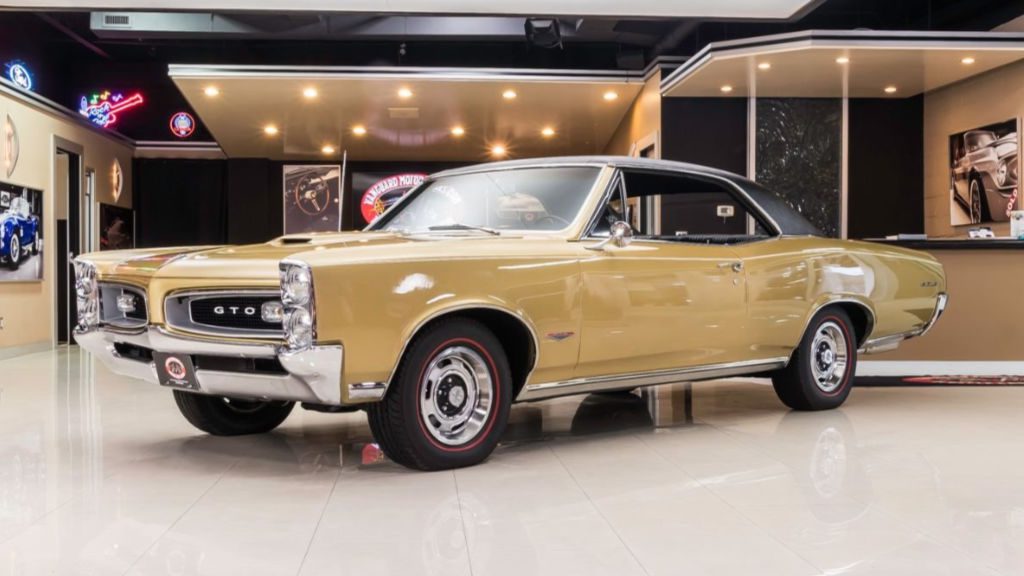
The Pontiac GTO Achieves Standalone Status
Not to be outdone, Pontiac elevated its flagship performer. In 1966, the Pontiac GTO finally broke away from being an option package for the LeMans and became its own dedicated model. The base engine was a formidable 389 CID V8 producing 335 horsepower, but the real excitement came from the performance upgrades.
This was the year Pontiac introduced the XS-code 389 package, featuring the famous Tri-Power setup. This configuration included a functional hood scoop, a more aggressive camshaft, and stiffened valve springs. To handle the extra power, Pontiac mandated a close-ratio four-speed manual, metallic brake linings, and a 4.33:1 limited-slip differential. These upgrades made the GTO one of the fastest and most desirable cars of 1966, further fueling the rivalry between Mopar and GM enthusiasts.
A Comprehensive List of 1966 Muscle Cars
By 1966, almost every major American manufacturer was vying for a piece of the high-performance market. From luxury-oriented cruisers to stripped-down drag racers, the variety was unprecedented.
| Year | Make | Model |
|---|---|---|
| 1966 | Buick | Gran Sport / Wildcat GS / Riviera GS |
| 1966 | Chevrolet | Chevelle SS / Corvette / Nova SS / Impala SS |
| 1966 | Dodge | Charger / Coronet |
| 1966 | Ford | Mustang GT / Fairlane GT / Galaxie |
| 1966 | Mercury | Cyclone / Comet |
| 1966 | Oldsmobile | 442 |
| 1966 | Plymouth | Barracuda Formula S / Satellite / Belvedere |
| 1966 | Pontiac | GTO / 2+2 / Grand Prix |
| 1966 | Shelby | GT350 / Cobra |
Conclusion
The 1966 model year was a watershed moment for the automotive industry. With the release of the street Hemi and the GTO’s rise to standalone stardom, it was clear that manufacturers were no longer just building cars—they were building icons. These vehicles offered a perfect blend of high-displacement power, innovative interior styling, and aggressive aesthetics that still define the “muscle car” identity today.
Whether you prefer the sophisticated interior of the Charger or the raw grunt of a Tri-Power GTO, 1966 offered something for every speed enthusiast. Which of these legends is your favorite? Share your thoughts on these classic 1966 machines and stay tuned for more deep dives into automotive history!
References
- Chrysler Hemi Engine History. (n.d.). Wikipedia.
- 1966 Pontiac GTO Buyer’s Guide. (2018). Hagerty.
- Dodge Muscle Car History. Muscle Cars Illustrated.
- Car and Driver Archives (1966). Performance testing reports.