
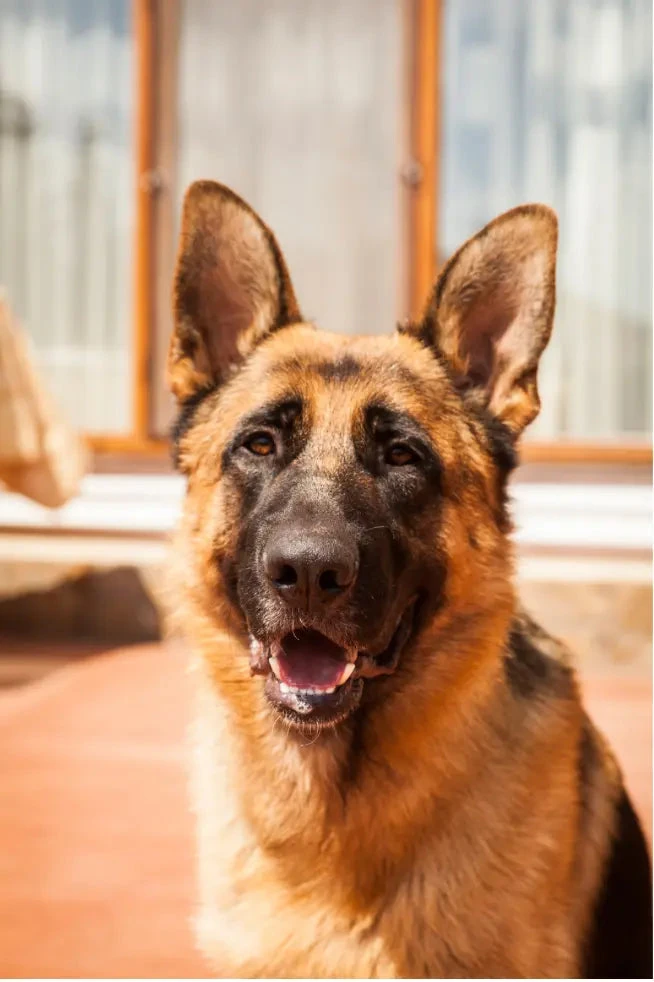
A long-haired German Shepherd needs brushing two to three times weekly, bathing every six to eight weeks, seasonal de-shedding during spring and fall, and trimming of specific areas like paw pads and feathering. Shaving is discouraged because it disrupts the double coat’s natural insulation and increases sunburn risk.
Why Long Coats Need a Different Grooming Routine
A long-haired German Shepherd carries a double coat: a coarser, longer outer layer (the guard hairs) sitting over a dense, soft undercoat that traps loose fur close to the skin. That undercoat is the reason grooming a long-haired dog takes more time than a short-haired one — the loose hair does not always fall out on its own, it gets caught in the longer outer coat and mats.
Because the coat sheds in two directions at once — surface fur that tangles and undercoat fur that packs down — a single brush or a single weekly session is rarely enough. Coverage needs to include brushing several times a week, periodic bathing, seasonal de-shedding, and light trimming, each addressing a different layer of the coat rather than one task standing in for all of them.
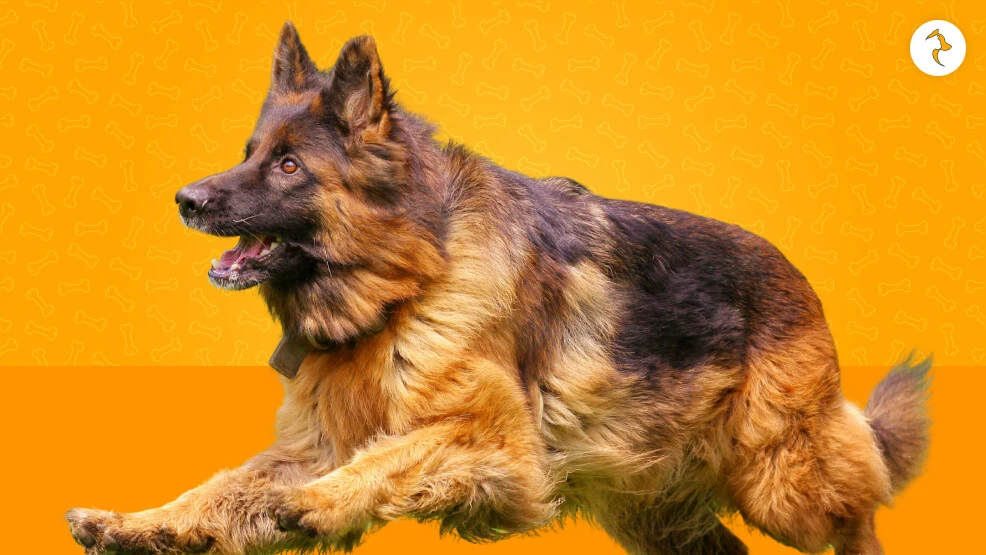
Shaving a long-haired German Shepherd is not recommended as a shortcut for any of this. The double coat actually helps regulate body temperature in both hot and cold weather, and shaving it removes that insulation while exposing skin that has had no prior sun exposure, raising the risk of sunburn. Regrowth after shaving can also come in patchy or texturally uneven, which is a cosmetic and comfort issue that takes months to resolve. Trimming specific areas, covered later in this guide, achieves the tidiness owners usually want from shaving without the downside.
Rather than memorizing a fixed schedule first, it helps to start from whatever problem is in front of you right now.
Matching Tools to Coat Problems
| If… | Then… |
|---|---|
| Surface tangles or light knots are visible on the top layer or feathering | Use a slicker brush with short, gentle strokes to work through the tangles without pulling the skin |
| Dense knots have formed in longer coat sections or behind the ears | Switch to a long-pinned brush or mat splitter to isolate and gently separate the tangled hair |
| Heavy loose undercoat is trapped beneath the top coat | Use a targeted de-shedding tool or undercoat rake to remove dead fur without cutting healthy hair |
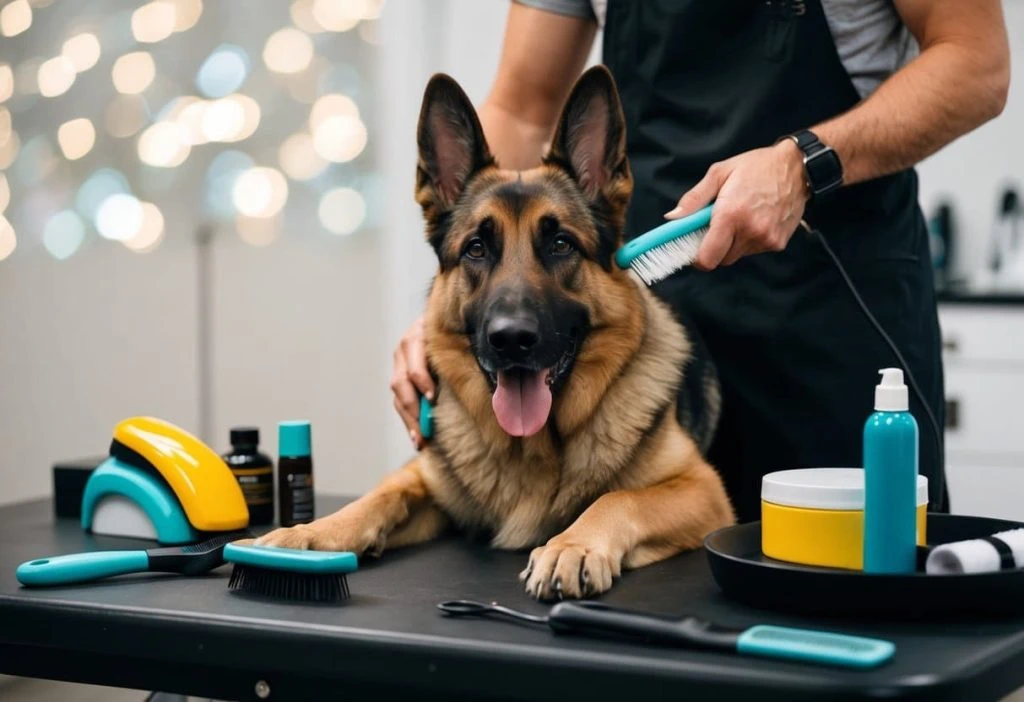
This problem-first approach matters because reaching for the wrong tool is one of the more common ways owners end up pulling on tangled hair instead of working through it — a mistake covered in more detail later in this guide.
Grooming Tools for Every Coat Problem
Most of the frustration owners describe with long-haired German Shepherd grooming traces back to using one brush for every job. Each tool below is built for a specific coat condition, and using the wrong one on the wrong problem is a common source of discomfort for the dog and wasted effort for the owner.
Grooming Tools and Techniques
| Tool Type | Coat Problem | Technique | Frequency |
|---|---|---|---|
| Slicker brush | Surface tangles and feathering | Short, gentle strokes working from tips outward | 2-3 times per week |
| Long-pinned brush | Deep tangles in longer coat sections | Part the fur and brush down to the skin layer | Weekly maintenance |
| De-shedding tool / undercoat rake | Loose undercoat during shedding season | Light, sweeping strokes avoiding downward pressure | Daily during peak shedding, weekly otherwise |
| Metal comb | Finishing pass and hidden knots | Glide gently through sections to catch resistance | End of every grooming session |
Slicker Brushes and Long-Pin Brushes for Tangles
A slicker brush has fine, closely-spaced wire pins set in a flat pad, and it is built for surface work — the feathering on the legs, chest, and tail where loose hair tends to tangle first. Used correctly, it skims the outer coat rather than digging into the skin.
A long-pinned brush reaches further into the coat than a slicker can, which makes it the better tool once a tangle has packed down closer to the skin, particularly behind the ears and along the ruff. The two are not interchangeable: starting with a long-pinned brush on light surface tangles can pull harder than necessary, while a slicker alone often cannot reach a deep knot at all.
A practical way to decide which to reach for mid-session is to run a slicker over a section first; if it glides through, move on, and if it catches, switch to the long-pinned brush before pulling harder with the same tool.

Undercoat Rakes and De-shedding Tools for Loose Fur
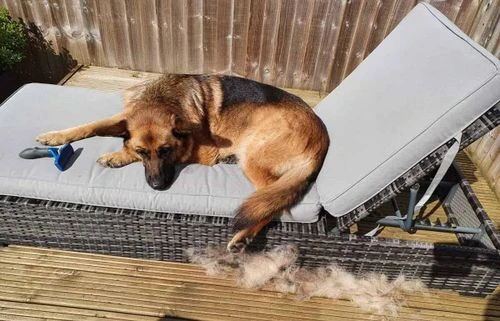
An undercoat rake has rounded teeth spaced to reach through the top coat and pull out dead undercoat fur without cutting the longer guard hairs. A de-shedding blade works on a similar principle but usually removes more volume per stroke, which makes it useful during the heaviest shedding weeks.
The undercoat needs targeted attention specifically when the coat looks dull or feels dense and "cottony" under the surface fur, or when brushing produces noticeably more loose fur than the previous session. That visual and textural change is a more reliable cue than a fixed calendar date, since shedding intensity varies dog to dog.
Combs, Mat Splitters, and Finishing Tools
A metal comb is the last tool in a session, not the first. Its job is to catch anything the slicker or rake missed — small knots low in the coat, or debris tangled near the skin — and it should glide through cleanly if the earlier brushing was thorough.
A mat splitter, sometimes called a dematting tool, has small blades that section a mat into thinner strips so it can be worked loose gradually instead of cut out whole. It is meant for mats that resist a comb but are not yet packed tight enough to require professional de-matting, a distinction covered further in the professional grooming section below.
Trimming scissors round out the kit for tidying feathering and stray hairs; blunt-tipped, curved grooming scissors are the safer choice near paws and ears compared to straight-bladed scissors, which carry a higher risk of a slip causing a nick.
Building a Home Grooming Kit
A workable home grooming kit for a long-haired German Shepherd, built around the sections above, typically includes: a slicker brush, a long-pinned brush, an undercoat rake or de-shedding tool, a wide-tooth metal comb, a mat splitter, blunt-tipped grooming scissors, and a double-coat-safe shampoo, covered in the bathing section further down.
Budget-tier versions of each tool will do the job for most home routines; the main difference at higher price points is usually pin durability and handle ergonomics for longer sessions, not a fundamentally different result. What matters more than price is keeping tools clean: hair and skin oil build up in brush pins and rake teeth, and a tool clogged with old fur works less effectively and can trap bacteria against the next area it touches. Rinsing pins after each session and letting them air-dry is enough to keep them working properly between uses.
How to Brush a Long Haired German Shepherd Without Discomfort
Brushing is the single task that prevents most other coat problems, but it is also the task most likely to cause discomfort when it is rushed or done against the coat’s growth pattern.
Step-by-Step Brushing Technique
Line brushing is the method most consistently recommended for double coats, and it works by tackling the coat in thin horizontal sections rather than brushing the whole body at once.
- Part the coat with your fingers or a comb to expose a single thin layer, roughly one to two inches wide.
- Brush that layer from the skin outward, following the direction the hair naturally grows rather than against it.
- Move the part down slightly and repeat, working through the section before moving to the next area of the body.
- Finish each worked section with the metal comb to confirm it moves through cleanly with no resistance.
Pressure should be light enough that the brush moves through the coat with minimal drag; if you feel the dog’s skin shift or the dog pulls away, that is a signal to ease off rather than push through with more force. Working in short two- to three-minute stretches per area, with breaks, tends to keep a dog more settled than one long uninterrupted session.
Recommended Brushing Frequency by Season
As a baseline, two to three brushing sessions a week is generally enough to stay ahead of surface tangles on a long-haired German Shepherd outside of shedding season. During spring and fall shedding periods, that frequency reasonably increases to daily short sessions, since the volume of loose undercoat coming free each day is higher.
The clearest sign the coat needs more frequent attention is not a date on the calendar but what the brush pulls out: if a single session produces noticeably more loose fur than it did a few days earlier, or if new tangles appear in the same spot twice in a row, that area needs a shorter interval between sessions until the shedding volume settles back down.
Coat Areas Prone to Hidden Mats
Certain zones mat well before the rest of the coat shows any problem, mainly because friction or moisture builds up there faster. Behind the ears, in the armpits, and around the collar line are the most common early spots, since fur there rubs against skin, a collar, or itself with every movement.
The hindquarters and tail feathering are the second common trouble spot, particularly on dogs that sit or lie on hard floors often, and mats here can hide against the skin without being visible from a quick glance. A practical habit is to check these specific zones by hand at the start of every brushing session, feeling for lumps or resistance under the surface fur before starting the line-brushing pass — catching a small mat here early is far faster than working through the same spot once it has packed down.
Building a Weekly Grooming Schedule at Home
A long-haired German Shepherd’s coat care fits into four recurring pillars rather than one long weekly chore. Spreading the tasks out keeps any single session short while covering brushing, bathing, de-shedding, and trimming on a schedule the coat actually needs.
- Conduct frequent brushing sessions, two to three times weekly at baseline, to prevent surface matting and distribute natural coat oils.
- Perform periodic baths, roughly every six to eight weeks or sooner if the coat looks dirty or carries an odor, using double-coat-safe products.
- Execute seasonal de-shedding sessions during spring and fall to clear heavy loose undercoat before it packs down into mats.
- Perform occasional trimming checks on paw pads, ears, and feathering for hygiene and shape, roughly once a month or as fur starts overhanging the paw pads.
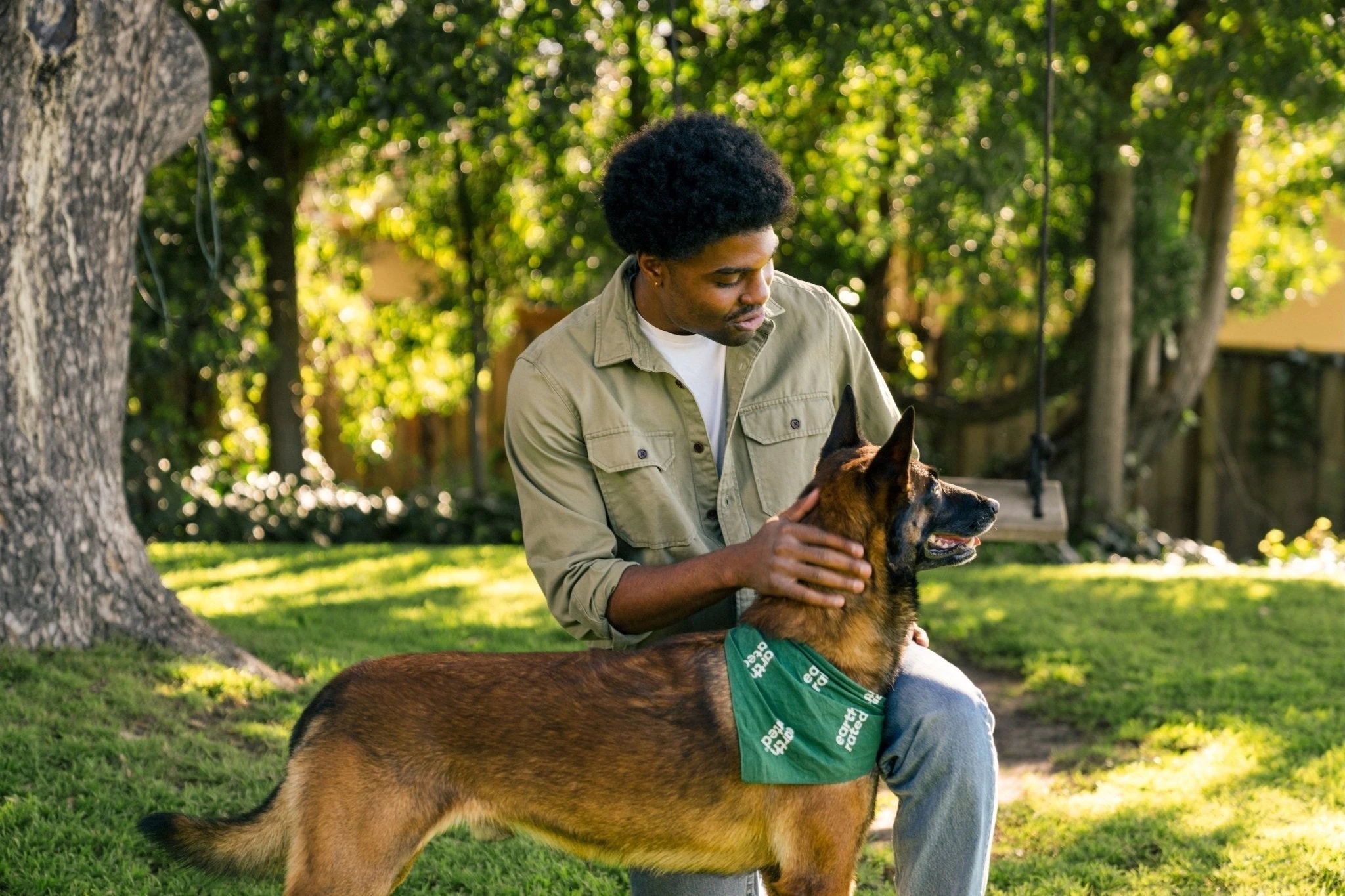
A simple way to keep this from slipping is to separate a quick daily check from the deeper weekly session. The daily check takes under a minute — a hand pass over the ears, armpits, and hindquarters to catch a new mat before it sets — while the weekly session is the full line-brushing pass described earlier.
During heavy shedding weeks, shift brushing to a light daily pass and hold bathing and de-shedding closer together, since a bath loosens packed undercoat and makes the following de-shedding session noticeably more effective. Some owners find a simple paper or phone checklist, ticking off brushing, bathing, and trim checks as they happen, keeps the routine from quietly slipping back to "whenever there’s time," which is usually when mats reappear.
De-shedding Techniques for Heavy Shedding Seasons
De-shedding tools remove more coat volume per stroke than a standard brush, which makes correct technique more important, not less — the same tool that clears loose undercoat efficiently can also pull healthy hair if it is used carelessly.
De-shedding Tool Technique Without Pulling Healthy Coat
The blade or rake should sit at a shallow angle against the coat, closer to parallel with the skin than perpendicular to it; a steep angle catches more resistance and is what typically causes pulling on healthy hair rather than the loose undercoat it is meant to remove.
Strokes should be short and gentle, following the direction of hair growth, with the tool lifted and reset between passes rather than dragged repeatedly over the same spot. If a section resists after two or three light passes, that resistance usually means a tangle rather than more loose undercoat, and it calls for the long-pinned brush or mat splitter instead of more pressure with the de-shedding tool.
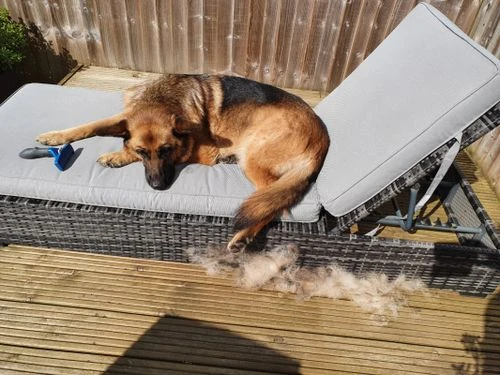
Over-de-shedding shows up as thinning patches, visible pink skin through the coat, or the dog flinching consistently at the same spot — any of those is a signal to stop de-shedding that area for a few days and let the coat settle before returning to it.
Seasonal Shedding Patterns
Spring and fall are the two periods when a long-haired German Shepherd typically sheds the heaviest volume of undercoat, as the coat transitions between seasonal densities. Outside those windows, shedding volume is usually lighter and more manageable with the standard two-to-three-times-weekly brushing routine.
During the peak weeks, de-shedding frequency reasonably increases from weekly to every other day or daily, matching the increased volume coming loose. Bathing shortly before a de-shedding session tends to make the loose undercoat easier to remove, since water and shampoo help lift fur that is already detached but still trapped against the skin.
Bathing a Long Haired German Shepherd: Products and Frequency
A long, thick double coat does not need frequent bathing the way a short coat might; overbathing is more often the problem than underbathing. Roughly every six to eight weeks is a workable baseline for most long-haired German Shepherds, adjusted earlier if the coat picks up a strong odor, visible dirt, or feels greasy to the touch.
Bathing too often strips the natural oils that keep the coat and skin healthy, which can leave the coat looking dull and the skin drier than it should be — a pattern covered again in the mistakes section below. A shampoo and conditioner formulated for double coats is a better choice than a generic pet shampoo, since these products are designed to work through a dense undercoat rather than just the surface layer, and human shampoo should never substitute for either, as its pH is a poor match for canine skin.
Drying afterward matters as much as the bath itself. A double coat holds water longer than a single coat, and skipping a thorough dry — letting the dog air-dry outdoors, for instance — leaves damp undercoat that mats faster and can develop a musty smell if it stays wet too long. Towel-drying first to remove excess water, then finishing with a cool or low-heat dryer while brushing through sections as they dry, keeps the coat from matting as it sets and helps you spot any tangles the bath loosened while they are still easy to work through.
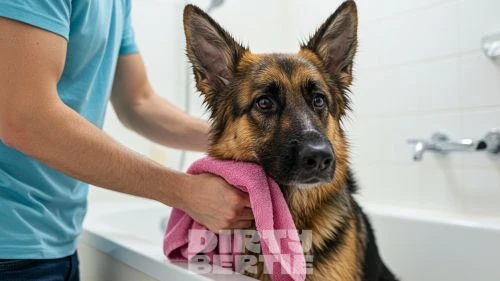
If the coat starts smelling noticeably "off" well before the usual six-to-eight-week mark, that is a reasonable signal to move the next bath earlier rather than wait out the full interval on a fixed schedule.
Trimming and Why Shaving Should Be Avoided
Trimming a long-haired German Shepherd is about tidying specific areas, not reshaping the whole coat, and it is the safer route to the neat look many owners actually want when they consider shaving.
Shaving removes the coat’s natural insulation, and because the skin underneath has had little to no prior sun exposure, it becomes considerably more vulnerable to sunburn once exposed. Regrowth after a shave is also frequently uneven in texture, sometimes taking months to return to its previous density and pattern — a cosmetic and comfort trade-off that rarely delivers the cooling benefit owners expect, since a healthy double coat already helps regulate temperature in both directions.
Targeted trimming avoids that trade-off. Paw pads and the fur between the toes benefit from a light trim to prevent debris and ice or gravel from getting trapped, ears and tail feathering can be tidied of stray mats or split ends, and overgrown feathering on the legs can be shaped without touching the main body coat.
Trim specific trouble areas — paw fur, ear fringes, tail feathering — rather than removing large sections of coat. Check paw pads regularly for trapped debris and trim excess fur between the toes carefully, using blunt-tipped scissors. Inspect ear fringes and tail feathering for stray mats before deciding whether a minor trim is needed. Avoid shaving the double coat entirely, since it removes natural sun protection and increases sunburn risk while regrowth may come in patchy.
For a mat that will not come loose with a comb or mat splitter, trimming it out with blunt-tipped scissors, held parallel to the skin and worked slowly, is generally safer than cutting it loose with a single snip close to the skin, which risks nicking the dog if it moves. If a mat is large, sits close to the skin, or the dog resists handling that area, that is a point where professional de-matting, discussed next, is the safer option over a home trim.
When to Choose Professional Grooming Over Home Care
A home routine covers most long-haired German Shepherd grooming needs, but a few observable situations are worth recognizing as the point where a professional groomer becomes the more practical and safer choice rather than pushing through at home.
Signs a Coat Needs Professional Attention
When to Call a Professional Groomer
| If… | Then… |
|---|
| Mats are packed tightly enough that they cannot be removed without pulling or risking cuts to the skin | Book a professional session for safe de-matting rather than continuing to work at them with scissors |
| The coat shows skin irritation, redness, hot spots, or an unusual odor under the fur | Have a groomer or veterinary professional assess the area before continuing routine brushing |
| Grooming sessions consistently take longer than the owner’s schedule allows, or the dog resists handling significantly | Shift the task to a professional groomer to keep sessions calm and consistent |
Severe matting is the clearest and most common trigger: if working through a mat with a comb or mat splitter causes visible discomfort or the mat does not loosen after several careful attempts, continuing to pull at it at home risks tearing the skin. A groomer with de-matting tools and technique can usually resolve this more safely than repeated home attempts.
Skin irritation or hot spots hidden under a thick coat are a second trigger, since these can worsen if left unaddressed, and a professional or veterinary check is the appropriate next step rather than more brushing. Time constraints are a more practical third trigger — a coat that is falling behind on its brushing schedule because sessions keep getting skipped is a coat that will benefit from a reset professional session even if there is no specific problem area yet.
Finding a Qualified Groomer
When searching for a groomer, looking specifically for experience with double-coated breeds is more useful than a general "dog groomer" search, since technique for a German Shepherd’s undercoat differs from single-coated breeds. Before booking, it is reasonable to ask what de-shedding method the groomer uses, whether they shave double coats by default, and how they typically handle a heavily matted section.
A groomer who defaults to shaving double-coated dogs without discussing alternatives is worth a second look, given the coat-health trade-offs already covered above. Local salons in most US areas list German Shepherd or double-coat experience directly in their service descriptions, which is a reasonable first filter when comparing options.
Typical Cost of Professional Grooming
Professional grooming sessions for a large, double-coated dog like a German Shepherd commonly run higher than sessions for smaller or single-coated breeds, since de-shedding and de-matting a dense undercoat takes more time. Severe matting, an add-on bath, or extra de-shedding work typically raises the price further compared with a routine maintenance visit.
Against that cost, home grooming supplies — the kit outlined earlier in this guide — are a one-time purchase that pays for itself over several sessions, though they trade a lower ongoing cost for the owner’s own time and, for severe cases, less specialized equipment than a professional setup provides.
Common Grooming Mistakes That Damage a Long Coat
A few recurring mistakes account for most of the coat problems owners run into, and each has a specific fix rather than a vague "be more careful" instruction.
Brushing only the visible top coat and skipping the undercoat is the most common one. It leaves the coat looking brushed on the surface while the denser undercoat mats underneath, which is why the line-brushing method described earlier — working in thin sections down to the skin — matters more than the total number of strokes.
Bathing too often is a close second. Stripping natural oils through frequent washing can leave the coat dull and the skin drier than it should be; sticking to the roughly six-to-eight-week interval, adjusted only when the coat is visibly dirty or smells, avoids this.
Using human shampoo, or a generic pet shampoo not suited to double coats, is a third recurring error, since the wrong pH or formulation can irritate skin that is already prone to trapping moisture under a dense coat. A double-coat-specific shampoo, mentioned in the bathing section, is a small swap with an outsized effect on coat condition.
The fourth mistake is letting small mats sit until they require cutting out. A mat caught early, while it still responds to a comb or slicker brush, takes a couple of minutes to resolve; the same mat left for two or three more weeks often packs down close enough to the skin that scissors become the only option. Checking the mat-prone zones — behind the ears, the armpits, the hindquarters — at the start of every session is the single habit that prevents this mistake from recurring.
If you take one thing from this guide and do it today, do the hands-on check behind the ears and in the armpits before your next brushing session — catching a mat there while it is still loose is the difference between a two-minute fix and a scissors-only removal a few weeks from now.
FAQ
Do long-haired German Shepherds need more grooming than short-haired ones?
Yes, long-haired German Shepherds require more frequent grooming because their dense double coat traps loose undercoat fur. Two to three weekly brushing sessions are baseline for long-haired dogs, compared to less frequent grooming for short-haired varieties, since the undercoat mats more easily without regular attention.
Is it normal for a long-haired German Shepherd to shed year-round?
Yes, long-haired German Shepherds shed year-round, but shedding volume increases significantly during spring and fall coat transitions. Outside those peak seasons, regular brushing handles normal shedding, but during spring and fall you may notice substantially more loose fur.
How long does home grooming usually take for a long-haired German Shepherd?
A single grooming session using line-brushing technique typically takes 15 to 30 minutes, depending on coat condition and the areas covered. Many owners find splitting this into short two-to-three-minute sessions across different body areas keeps the dog more settled and makes the routine easier to maintain.
Should puppies be groomed differently than adult long-haired German Shepherds?
Puppies benefit from early exposure to grooming and the tools you’ll use as adults, but their coats are often less dense initially. Start grooming routines early with gentler handling so they grow accustomed to the process, then adjust frequency and technique as their adult coat develops.
Can regular grooming reduce shedding around the house?
Yes, regular brushing removes loose undercoat before it falls around your home. Consistent grooming two to three times weekly, and daily during shedding seasons, significantly reduces the amount of loose hair you find on floors and furniture by capturing it during sessions.
Are long-haired German Shepherds more prone to matting than other double-coated breeds?
Long-haired German Shepherds have a dense double coat that mats readily if not groomed regularly. While other double-coated breeds require similar attention, the length and density of a German Shepherd’s coat make consistent brushing especially important to prevent mats from forming in high-friction areas like behind the ears.