
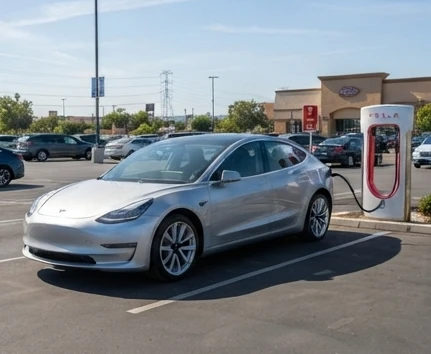
An EV station is a location with equipment that supplies electricity to charge an electric vehicle. Drivers can find nearby stations through charging apps, network maps, and government databases, then filter locations by connector type, charging speed, availability, and payment options to select a compatible charging point.
Finding an EV station can be frustrating when you need a charger that is available, compatible with your vehicle, and reasonably priced. Many electric vehicle owners struggle with real-time charger availability, unclear charging fees, and uncertainty about whether a home charging setup will work with their electrical system. This guide explains how to locate nearby charging points, compare charging speeds and costs, and choose a home installation approach that fits your vehicle and daily driving needs.
An EV station is a location with equipment that supplies electricity to charge an electric vehicle. You can find nearby stations through apps such as PlugShare, network apps, and government station maps, then filter results by connector type, charging speed, and current availability. The right choice depends on your vehicle’s plug compatibility, the charging network, the time you have available, and whether home charging is practical.
Finding an EV station nearby and checking live availability
An EV station connects an electric vehicle to electrical power through EV supply equipment (EVSE), which manages communication between the vehicle and the power source. For drivers, the most important factors are not only where a charging point exists, but whether it is working, available, and suitable for the vehicle’s charging limits.
A station map may show dozens of electric car charging locations, but only a smaller number may fit a specific trip. Checking connector type, charging speed, and current status before driving reduces the risk of arriving at an unusable charger.
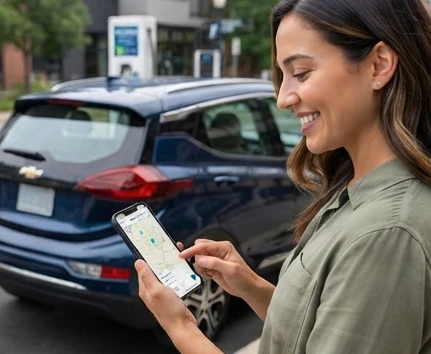
Apps and maps for locating charging points
The easiest way to find an EV station nearby is to combine a navigation app with a dedicated charging map. Tools such as PlugShare allow drivers to view station locations, user comments, connector information, and availability reports. Government databases such as the Alternative Fuels Data Center (AFDC) also provide public charging location information.
When searching for an EV charging station near me, use filters instead of selecting the closest location automatically. A station that is two miles farther away may be a better option if it has a working DC fast charger rather than a slower Level 2 charger.
Useful filters include:
- Connector type: Select J1772, CCS, NACS, or another plug supported by your vehicle.
- Charging speed: Separate Level 2 chargers from DC fast chargers when travel time matters.
- Access requirements: Check whether the station requires an account, membership, or payment method.
- Availability: Look for live status information when the app provides it.
Charging networks also provide their own apps. Networks such as ChargePoint, Electrify America, and EVgo display station locations, pricing details, and account features. Using a network app can provide more accurate payment and availability information for that provider’s equipment.
Checking compatibility before you drive
Connector compatibility is one of the most common reasons a charging stop fails. The vehicle and charger must use compatible hardware, and the vehicle must support the charging speed offered by the station.
A faster charger does not automatically mean faster charging. The vehicle’s onboard charging system, battery condition, and maximum charging capability determine the actual power received.
Before leaving for a station, check:
- The connector type listed by the station.
- The maximum charging speed supported by your vehicle.
- Whether the station requires an adapter.
- Whether the charging location has parking rules or time limits.
For example, a vehicle equipped for slower AC charging may connect physically to a higher-powered station but still charge at a lower rate. Compatibility is both a plug question and a vehicle capability question.
EV charging station types and charging performance
Charging technology is usually divided into Level 1, Level 2, and DC fast charging. The difference is mainly power output, charging speed, and where each type makes practical sense.
Choosing the correct charger is less about buying the fastest option and more about matching charging speed to daily mileage, parking time, and available electrical capacity.
Level 1, Level 2 and DC fast charger differences
The following comparison shows the typical role of each charging type.
Charging Type Comparison
| Charging type | Typical power | Charging speed | Common connector | Best use |
|---|---|---|---|---|
| Level 1 | 1.4 – 1.9 kW | 3-5 miles of range per hour | J1772 / NEMA 5-15 | Overnight home charging for vehicles with low daily mileage |
| Level 2 | 3.3 – 19.2 kW | 10-25 miles of range per hour | J1772 / CCS / NACS | Daily charging at home or workplace |
| DC Fast Charger | 50 – 350+ kW | 60-80% battery charge in 20-30 minutes | CCS / CHAdeMO / Tesla NACS | Long-distance travel and rapid public charging |
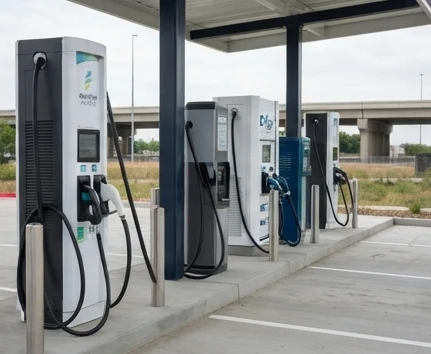
A Level 1 charger is the simplest option because it can use a standard household outlet, but it may not replace much driving range quickly. Level 2 charging usually requires a dedicated circuit and is the common choice for home installations because it balances speed and installation complexity.
DC fast chargers use much higher power levels and are designed primarily for public locations. They are useful during road trips because they can add substantial range during a short stop, but frequent use may cost more than home charging depending on local pricing.
Connectors, power output and vehicle compatibility
Connector standards continue to evolve. In the United States, J1772 has been widely used for AC charging, CCS has been common for DC fast charging, and Tesla vehicles have traditionally used the Tesla connector, now commonly referred to as NACS.
A charging plan should consider both today’s vehicle and future compatibility. A homeowner buying equipment should confirm whether the charger supports the connector used by the current vehicle and whether adapters or newer standards may affect future vehicle choices.
Common compatibility checks include:
- J1772: Common AC charging connector for many electric vehicles.
- CCS connector: Combines AC charging capability with DC fast charging capability for supported vehicles.
- Tesla Supercharger: Tesla’s proprietary fast charging network, with access expanding for some non-Tesla vehicles depending on equipment and agreements.
- NACS: A connector standard increasingly used across the North American market.
From an editorial review of EV charging information, the recurring failure mode is treating charging speed as a standalone feature. A charger with higher power output is only valuable when the vehicle, electrical system, and charging location can use that power effectively.
Public charging costs and choosing the right charging network
Public charging prices vary by location, network, electricity rates, and payment structure. Some stations charge by kilowatt-hour (kWh), some by time connected, and some combine charging fees with membership programs.
The average cost to charge an electric vehicle depends on battery size, electricity price, and how much energy the vehicle needs. Comparing only the advertised charger speed can hide important differences in total cost.
Pricing models used by public EV stations
Public EV charging station cost per kilowatt-hour is often easier to compare with home charging because it directly reflects the electricity used. However, some regions regulate how charging providers can bill customers, so pricing models differ.
Common pricing structures include:
- Per kWh pricing: Customers pay for the energy delivered to the vehicle.
- Per minute pricing: Customers pay based on charging time, often where energy measurement rules vary.
- Membership pricing: Drivers pay a subscription fee to receive discounted charging rates.
- Idle fees: Some networks charge when a vehicle remains connected after charging is complete.
To reduce charging costs, apply these practical rules:
- Compare the membership fee against expected monthly public charging use before subscribing.
- Use Level 2 charging when the vehicle will remain parked for several hours.
- Avoid occupying fast chargers after charging finishes because idle fees may apply.
Comparing major charging networks in the United States
Network choice affects station availability, payment experience, and trip planning reliability. A driver who frequently travels long distances may value fast charging coverage more than the lowest single-session price.
Major EV Charging Networks
| Network | Pricing model | Membership option | Typical charging speed | Best for |
|---|---|---|---|---|
| Tesla Supercharger | Per kWh or per minute depending on location | Monthly membership options may apply for some users | Very fast, up to 250+ kW | Tesla drivers and compatible vehicles |
| Electrify America | Per kWh or per minute depending on location | Pass Plus membership option | Fast to very fast, 150-350 kW | Long-distance EV travel |
| ChargePoint | Pricing set by station owner | Not always required | Mostly Level 2 with some DC fast charging | Workplace, retail, and public charging |
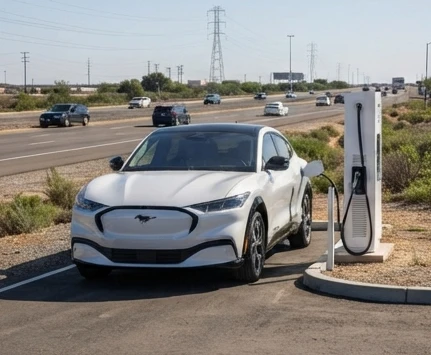
Major charging networks serve different situations. A commuter may prioritize convenient workplace charging, while a highway traveler may prioritize DC fast charger locations along major routes.
When comparing networks, check more than station count. Reliability information, connector availability, payment options, and real-time status are often more useful for daily driving decisions.
Installing a home EV charging station
A home EV charging station can make daily charging more convenient, but installation depends on the home’s electrical capacity, charger location, and local requirements. A proper installation begins with checking the existing electrical system rather than choosing equipment first.
Electrical requirements and installation process
The electric vehicle charging station installation process usually includes evaluating the electrical panel, selecting charger placement, installing a dedicated circuit, and completing any required inspection.
A common mistake is assuming every home can immediately support a high-power Level 2 charger. The electrical panel may have limited capacity, especially in older homes with existing large loads such as electric heating or appliances.
A safer installation process is:
- Check the available capacity in the electrical panel and identify whether a dedicated circuit is possible.
- Select a charger power level that matches the vehicle and home electrical limits.
- Have electrical work completed according to local electrical requirements.
- Confirm the charger operates correctly after installation.
For continuous loads, a commonly used calculation rule is:
Required circuit capacity = Charger rated current x 1.25
The variables are:
- Charger rated current: The continuous current drawn by the charging equipment.
- 1.25 safety factor: A factor used for continuous electrical loads.
Example: A Level 2 charger rated at 40A requires a circuit rated for at least 50A (40 x 1.25 = 50A). The exact wire size and installation method depend on local codes, distance, and equipment specifications.
Installation cost depends heavily on the distance between the electrical panel and charger location.
Installation Cost Estimates
| Installation scenario | Equipment cost | Labor cost | Electrical upgrade | Typical total cost |
|---|---|---|---|---|
| Basic installation near electrical panel | $400 – $800 | $300 – $600 | No upgrade required | $700 – $1,400 |
| Longer cable route from panel | $500 – $1,000 | $600 – $1,200 | Conduit or additional wiring may be needed | $1,100 – $2,200 |
| Older electrical system requiring upgrades | $800 – $1,200 | $1,000 – $1,500 | Panel and breaker upgrades may be needed | $1,800 – $2,700 |
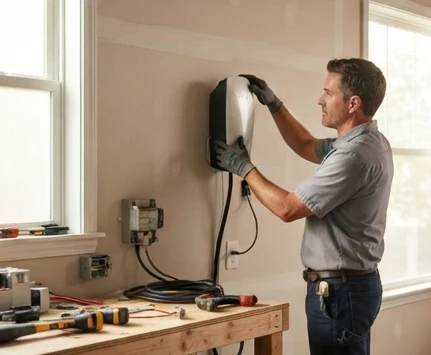
These figures are estimates for planning, not guaranteed quotes. Local labor rates, permit requirements, and electrical conditions can change the final price.
Choosing the best home EV charging station
The best home EV charging station is the one that matches the vehicle, available electricity, parking routine, and future needs.
Consider these factors before buying:
- Charging speed: Choose enough power for daily driving needs rather than paying only for the highest rating.
- Connector support: Confirm J1772, NACS, or adapter requirements.
- Indoor or outdoor installation: Check weather ratings and mounting requirements.
- Smart features: Decide whether scheduling, energy monitoring, and app controls are useful.
- Electrical compatibility: Verify that the home circuit can safely support the charger.
For many households, a Level 2 charger provides the practical balance between installation cost and daily convenience. A higher-powered unit may offer limited benefit if the vehicle cannot accept the additional power.
Home charging economics, incentives and business profitability
Charging decisions involve more than hardware. Homeowners need to compare installation costs and electricity savings, while potential station owners need to understand utilization, operating expenses, and revenue sources.
In practical EV infrastructure planning, the easy-to-miss step is separating equipment cost from the economics of actually using the charger. A fast charger with low demand may perform worse financially than a slower charger in a high-traffic location.
Home installation costs and available incentives
Home charging economics depend on several variables:
- Electricity price in the local utility area.
- Vehicle efficiency and battery size.
- Daily driving distance.
- Installation requirements.
- Available rebates, tax credits, or local incentive programs.
Government incentives change frequently and depend on location and eligibility rules. Before purchasing equipment, check current federal, state, utility, and local programs that may support EV charging installation.
A practical way to estimate home charging value is to compare the cost of electricity used at home with the typical cost of equivalent public charging sessions. The calculation requires the vehicle’s energy consumption and the local electricity rate.
For example:
Charging cost estimate = Energy used (kWh) x Electricity price per kWh
This estimate does not include installation cost recovery, maintenance, or demand charges that may apply in some situations.
Revenue potential for EV station owners
EV stations can generate revenue through charging fees, memberships, advertising partnerships, or services provided at the charging location. However, profitability depends heavily on utilization.
The main business factors include:
- Installation investment: Hardware, electrical upgrades, construction work, permits, and site preparation affect initial costs.
- Electricity cost: The difference between energy purchase cost and customer charging price affects gross margin.
- Utilization rate: A charger must have enough daily use to recover fixed costs.
- Maintenance and software fees: Network services, repairs, and payment processing reduce revenue.
A simple operating model is:
Gross charging revenue = Energy sold x Customer price per kWh
An estimate for break-even planning should include charger utilization, not just charger availability. For example, a station that is technically open 24 hours but rarely used may struggle to recover installation expenses.
A practical benchmark used in planning models is to evaluate whether average daily usage reaches a meaningful portion of available capacity rather than focusing only on maximum charger output. The exact break-even point depends on electricity costs, financing, and site expenses.
For a potential station owner, the strongest indicators are observable: steady traffic near the site, nearby businesses that create waiting time, limited competing chargers, and predictable parking access.
Choosing the best EV charging solution for your needs
The right charging strategy depends on where the vehicle is parked, how far it is driven each day, and whether fast charging access is available when needed.
Charging Approach by Use Case
| Use case | Home charging | Public charging | Recommended choice | Reason |
|---|---|---|---|---|
| Single-family home with daily driving | Convenient and usually available overnight | Requires additional travel | Home charging | Uses existing parking time for charging |
| Apartment resident without dedicated charging | May not be possible without building support | Depends on nearby charging locations | Public charging | Uses available shared infrastructure |
| Frequent long-distance driver | Cannot replace highway charging needs | Provides rapid energy during trips | Public charging | DC fast charging supports travel schedules |
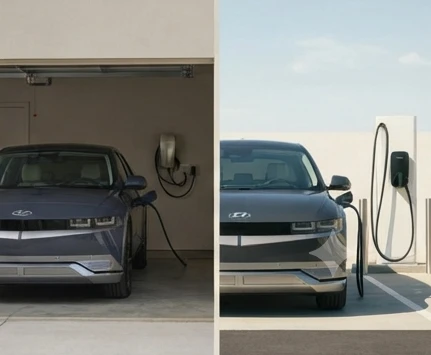
Home charging versus public charging
Home charging usually provides the simplest routine because the vehicle can charge while parked. It works especially well for drivers who return home regularly and can install suitable equipment.
Public charging provides flexibility for apartment residents, travelers, and drivers who need additional range away from home. The trade-off is that charging requires planning around station location, availability, and pricing.
A balanced approach is common: use home charging for regular driving and public DC fast charging for longer trips or situations where extra range is needed.
Decision framework by driving habits
Use your daily routine as the main selection guide:
| Situation | Charging approach |
|---|---|
| You drive short daily distances and park at home | Consider Level 2 home charging for overnight convenience |
| You cannot install equipment where you live | Build a routine around reliable nearby public charging locations |
| You travel long distances frequently | Prioritize vehicles and routes with strong DC fast charging access |
| Multiple drivers share one charger | Consider scheduling features and connector compatibility |
Choose three nearby charging points today in your preferred map app, verify their connector types and live availability, and save the locations you can actually use; this creates a reliable backup plan before your next low-battery situation.
FAQ
How many EV stations are in the US?
The number of EV stations in the US changes as new charging locations are added. Drivers can find current public charging locations through station maps, network apps, PlugShare, and government databases such as the Alternative Fuels Data Center (AFDC).
How long can an electric vehicle stay connected after charging is complete?
An electric vehicle can remain connected after charging is complete, but some public stations may apply idle fees when a vehicle stays connected after charging finishes. Checking network rules and station policies helps avoid additional charges.
Can rain affect EV station safety?
EV stations are designed to provide charging through EV supply equipment (EVSE), which manages communication between the vehicle and power source. Drivers should use properly installed equipment and follow charger instructions when using public or home charging equipment.
Do all electric vehicles work with every public charging station?
No. Electric vehicles do not automatically work with every public charging station. Drivers need to check connector type, charging speed support, adapter requirements, and whether the vehicle can use the station’s charging technology before starting a session.