
Elvis Presley, the King of Rock and Roll, shared his life with many, but few relationships were as profound and enduring as his bond with Ann-Margret. Their connection, both on and off the screen, became one of the most memorable chapters in Elvis’s life, offering a glimpse into the personal world of a man whose public persona often overshadowed his private struggles. Their story, rooted in the golden era of American music and cinema, continues to captivate fans and historians alike, showcasing the intersection of love, artistry, and the complexities of fame.
A Fateful Meeting on the MGM Soundstage
In early July 1963, the paths of Elvis Presley and Ann-Margret crossed on a soundstage at Radio Recorders studios in Hollywood. The occasion was the production of MGM’s Viva Las Vegas, a film that would mark a pivotal moment in both their careers. At 28, Elvis was already a superstar, with 14 films under his belt, while Ann-Margret, just 22, was on the cusp of stardom following her breakout role in Bye Bye Birdie. The chemistry between them was immediate, though neither could have predicted the depth of the connection that would follow.
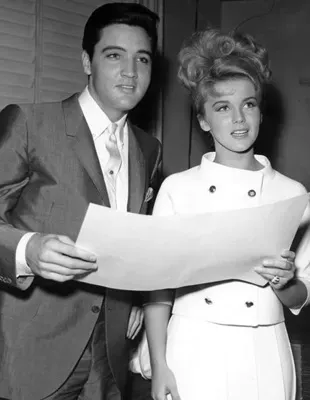
Ann-Margret later recalled their first encounter in her 1994 autobiography. The MGM soundstage was nearly empty, save for a piano and a few of Elvis’s entourage observing their boss. Director George Sidney introduced them, and the moment was immortalized by a studio photographer. “Elvis Presley, I’d like you to meet a wonderful young lady, Ann-Margret,” Sidney said. Their handshake and simultaneous words—“I’ve heard a lot about you”—broke the ice and set the tone for a relationship that would transcend the professional.
A Partnership Built on Music and Mutual Respect
Before filming began, Elvis and Ann-Margret recorded their musical numbers. On July 9-10, they laid down their solo tracks, and on July 11, they collaborated on three duets: “The Lady Loves Me,” “You’re the Boss,” and “Today, Tomorrow, and Forever.” The energy they shared on stage was electric, a visceral connection that Ann-Margret described as a “fiery pent-up passion.” Their movements mirrored each other’s, creating a synergy that was as much a dance as it was a performance.
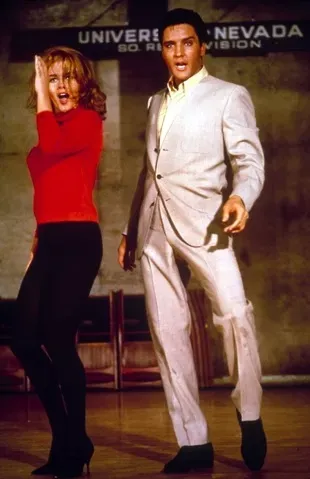
Filming took them to Las Vegas, where they stayed at the Sahara Hotel from July 15 to 26. The cast and crew then returned to Los Angeles to complete the film, wrapping up in early September. Ann-Margret noted that while their initial interactions were cordial, others saw the sparks between them from the start. The press soon caught on, reporting on their hand-holding and private lunches. Their connection was undeniable, and it wasn’t long before their professional partnership blossomed into a personal romance.
Understanding Elvis’s World
As they spent more time together, Ann-Margret discovered the many commonalities they shared: a love for motorcycles, family, privacy, faith, and late-night conversations. She quickly became a part of Elvis’s inner circle, earning the respect of his Memphis Mafia. Elvis’s cousin, Billy Smith, later reflected that Ann-Margret understood Elvis in a way few others did, including his need for the company of his friends. Marty Lacker, one of Elvis’s closest associates, remembered her fondly: “She genuinely liked people, and she liked every one of us. She wasn’t intimidated or threatened by us. We called her ‘Rusty’ because of her red hair and her character in the movie.”
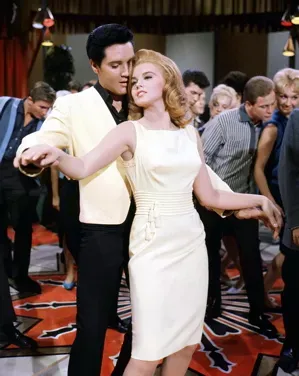
Elvis’s trust in Ann-Margret grew as they spent more time alone. She became one of the few people with whom he felt comfortable sharing his vulnerabilities. In the quiet moments, away from the public eye, Elvis opened up about his dreams, desires, and insecurities. Ann-Margret later wrote that these private conversations, often under the starlit skies of Los Angeles, allowed her to see the man behind the legend.
The Camera Angle Controversy: A Test of Egos
Their relationship was not without its challenges. During the filming of Viva Las Vegas, a controversy arose over the alleged favoritism director George Sidney showed toward Ann-Margret. Members of Elvis’s entourage, including Red West and Lamar Fike, accused Sidney of giving Ann-Margret more favorable camera angles at Elvis’s expense. Elvis himself reportedly complained to Colonel Parker, his manager, who then confronted the producers to ensure the film remained an “Elvis Presley picture.”
Despite the tension, the final cut of Viva Las Vegas featured Elvis prominently, with six solo musical numbers compared to Ann-Margret’s two. Her dancing prowess was highlighted, but the film ultimately belonged to Elvis. Ann-Margret never addressed the controversy in her autobiography, and none of Elvis’s associates blamed her for the perceived bias. Their personal relationship remained unaffected, a testament to the strength of their bond.
A Love Story Cut Short by Commitments
By the fall of 1964, their relationship had deepened into a full-blown love affair. Elvis’s cousin, Lamar Fike, later remarked, “Elvis’ affair with Ann-Margret was not just an affair. He was really in love with her.” Marty Lacker echoed this sentiment, noting that both cared deeply for each other. Ann-Margret, however, chose to focus on the lighter aspects of their relationship in her book, such as their motorcycle rides and shared adventures.
Their romance continued even after filming wrapped. Jerry Schilling, a member of Elvis’s inner circle, recalled seeing Ann-Margret enter Elvis’s California home late at night in 1964, using her own key to access his bedroom. She would sign letters to Elvis as “Bunny” or “Thumper,” and he, in turn, commissioned a pink bed for her, knowing her love for the color.
Yet, as Ann-Margret reflected in her autobiography, their love affair was doomed by the realities of Elvis’s life. “There were other factors in Elvis’s life that forced him apart from me, and I understood them,” she wrote. Their relationship lasted nearly a year before coming to an end. Elvis’s commitment to Priscilla Presley culminated in their marriage on May 1, 1967, in Las Vegas. Ann-Margret followed suit a week later, marrying actor Roger Smith in the same city.
A Lifelong Friendship and Mutual Support
Despite the end of their romantic relationship, Elvis and Ann-Margret remained close friends for the next decade. When Ann-Margret made her Las Vegas stage debut in June 1967, Elvis sent her a guitar-shaped floral arrangement, a gesture he repeated for all her subsequent openings. In return, Ann-Margret attended Elvis’s shows whenever possible, including his historic opening at the International Hotel on July 31, 1969.
Their bond was tested in the 1970s as both struggled with personal demons. Elvis battled prescription drug abuse, while Ann-Margret faced alcohol addiction. She later described her lowest point: “I reached a point where my days and nights blended into one continuous, foggy state of inebriation.” Ann-Margret eventually overcame her addiction, but Elvis was not as fortunate.
In early 1977, rumors of Elvis’s declining health reached Ann-Margret. When Joe Esposito, a member of Elvis’s entourage, visited her show at the Tropicana in Las Vegas, she asked about Elvis’s well-being. Esposito reassured her, but the truth was far grimmer.
A Devastating Loss and Lasting Legacy
On August 16, 1977, Ann-Margret received the devastating news of Elvis’s passing. Despite Joe Esposito’s advice to stay away from the chaos in Memphis, she insisted on attending the funeral. At Graceland, she embraced Elvis’s father, Vernon, and the two shared a moment of silent grief. “He was so proud of you,” Vernon whispered.
Three months later, Elvis’s father and Colonel Parker asked Ann-Margret to host Memories of Elvis, a two-hour NBC tribute. She described it as one of the most challenging tasks of her career. In 1979, when Vernon fell seriously ill, Ann-Margret flew to Memphis to visit him. Their conversations were filled with laughter, tears, and shared memories of Elvis. Vernon passed away on June 26, 1979, but Ann-Margret’s loyalty to the Presley family never wavered.
Marty Lacker once mused, “If Elvis had ended up with Thumper, this whole story might have wound up differently.” Could Ann-Margret have saved Elvis from his self-destructive tendencies? It’s a question that lingers, though both knew their love story was never meant to last. What remains is a legacy of mutual respect, admiration, and a connection that transcended the boundaries of time and fame. Their story is a testament to the power of love, artistry, and the enduring impact of the golden era of American music.